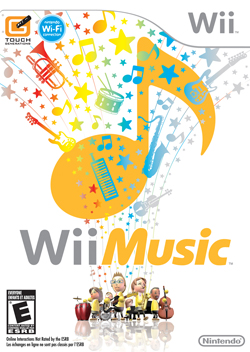
Wii
Music combines over sixty instruments and four different game
modes for you to wave your Wii Remotes at until you’re bored. The
four modes open to you are Lessons, Jam, Videos and Games. At first
glance this seems like you’re getting your money’s worth, but in
the end you’ll just be doing the same arm movements to the beat of
every song.
The
gameplay revolving around
Wii Music is all about making you
feel like you’re in a band. It does a good job of recreating the
mass amount of instruments you’ll get to play, such as a violin,
drums, guitar or even barking like a dog; though, each will have you
just waving your arms or pressing buttons in no set order.
Unfortunately, that’s all there is to the game.
Once
you've started up the game, you will be instructed on how to work
some of the most basic instruments. As every type of instrument you
play works off similar mechanics, this is a good way to make sure you
know how to play anything in the game.
As
mentioned above,
Wii Music game has four game play modes that
are all unlocked for you from the get go. The most basic of these is
Jam which is like a "quickplay" mode. In Jam you get three
choices, Instrument Improv, Quick Jam and Custom Jam. Instrument
Improv lets you pick one of the available instruments and just lets
you mess around with it. After a few seconds "Tutes"
(computer players) will join you until you have a full band. It does
a good job of making you feel like, all together, you’re making
music, since the computer players will play their instruments at the
same pace you are. This won’t last for long though as you don’t
have any task or goal to this besides just play until you’re done.
Quick Jam is exactly what it sounds like; you get set up with a
random instrument and song and go right into it. Custom Jam is
similar, except you get to choose which instrument you want and which
ones you want the Tutes to be playing along with you.
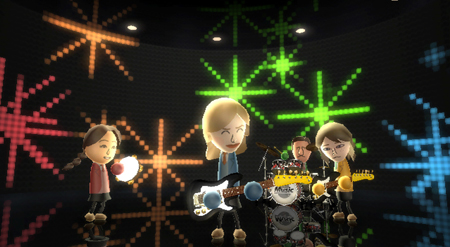
Your Miis rock out while you flail your arms about. Yep, that rhymes.
The
next mode is Lessons, which, again, is just what it sounds like,
tutorials. It includes the lesson you had to go through when you
first began playing, and another for harder skills.
The
third mode is Games, which I personally found to be the best of the
four choices since it contained the most in terms of varying game
play elements. In this you can choose Mii Maestro, Handbell Harmony
or Pitch Perfect. Mii Maestro is the least enjoyable of the three.
You get to be a conductor. This includes waving your wii-mote up and
down as the virtual Mii band plays along at your speed. The
difficulty here goes up by the addition of a percentage at the end.
You get a higher (better) percent if you played at the correct speed
and hit A or B to make the band play a special note at the right
times. The downfall here is that there is nothing to tell you when to
play these notes or the correct speed to go at. You have to guess
whether you’re going at the right speed or not; and finding out
when there are slow parts can be impossible if you have never heard
the song before.
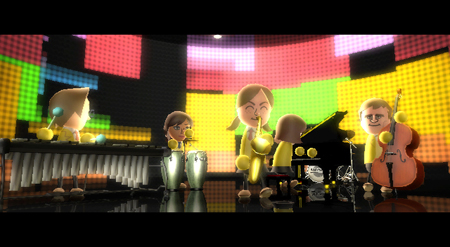
Prepping for a solo.
Handbell
Harmony was my personal favourite part of the game by itself. It’s
the closest to an average rhythm based game, where you can see the
notes coming across and what the correct time to swing your “bell”
is. Each song is made up of eight different bell sounds and you
control two of them. When you see your color of bell coming, you
either swing the Nunchuck or the Wii Remote in time with the song to
play it properly. To make it harder, the game throws in special notes
that make you have to hold a button down while swinging to hit the
note. However, this mode is generally too easy and since you only
control two of the eight bells, there will be times where you’re
either just the back beat or you might not even play that often
because you might be an uncommon bell pitch.
Pitch
Perfect is small mini game that is taken a bit too far. You get eight
levels of difficulty, fittingly titled Level 1 though 8. In this game
you need to match tones and pitches by singing or playing Mii’s to
one another. You will encounter things like “match the Mii that has
the same pitch as the speaker” which will require you to listen to
each Mii sing and then select one. This mode gets boring quickly and
you won’t enjoy every minute of the eight levels if you feel the
need to go through them all.
Videos
is the final mode. This is more of a music video like option where
you can watch any of the past performances you have saved. In modes
like Custom Jam, you’re able to save the performance you just did
in order to watch it later here. This is also where the online aspect
of
Wii Music comes in, because it allows you to share your
video with friends who own the game. The downfall to this is it’s
just for watching. Most people would rather go and play that song
than sit there and watch their Mii(s) play it by themselves.
The
graphics in the game are fine, but you shouldn’t expect them to be
bad since we’re dealing with almost Lego like detail for the Miis.
Apart from that, everything is just a video played behind your own
personal character so you don’t control very much of it.
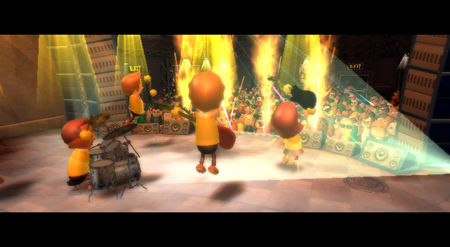
Pleasing the crowd.
The
biggest benefit in
Wii Music would have to be its library of
songs. The game contains over thirty songs that range from
Happy
Birthday To You all the way to
Material Girl by Madonna.
Nintendo has even thrown in some of its own songs like
F-Zero’s
Mute City Theme and
The Legend of Zelda Theme. The
Nintendo songs are, personally, my favourite to play and I had the
most fun with them. The majority of these songs are fun to play,
especially since you can customize the instruments playing them to
sound themes like “Galaxy” which makes everything sound all
techno-like. However, the overall selection of music probably isn’t
what most people really want to hear/play. The bottom line – Does
anyone really want to play
O Christmas Tree that badly?
The
worst part of
Wii Music is that it has no replay value. Any
replay value you will find will just be because you, most likely,
didn’t play it for very long during your last gaming session. The
game's core gameplay element is so linear that you won’t find much
of a need to continue with it for very long. After you get the just
of how every instruments mimics a good portion of the others, there’s
nothing really new to experience.
Unlike
most music rhythm games, there’s no “note chart” that is
scrolling across the screen. You’re left to play the notes in
whatever way you like. Though it does try to mix things up a bit, for
example, hold the A button down when swinging to hit the drum so you
make a different noise. These don’t really have much of an impact
to the game as it plays the note it has to in order to complete the
song properly. This means that if you’re not playing outside the
original song chart, no matter what special notes you’re playing,
they won’t sound different. This gives you the feeling that you
don’t have very much control.
Overall,
Wii Music feels more like a full priced mini game collection
that had a lot of work put it in; despite the fact that this work
didn’t help make it a game worth the money you’ll put down. The
repetitive gameplay will make you wish for more and the short extra
modes will only be fun for an hour at tops. The game does offer four
modes, but only two of them let you actually play parts of the game.
And the gameplay you’ll be faced with is either vertical arm waves,
or hitting the two buttons when you think the timing is appropriate.
Wii Music is just too linear.
Wii Music has an optional drum mode, if you've got the Balance Board.
It
should be noted that Wii
Music
can be played with the Balance
Board for use with a special in-game drum
mode. This allows you to not only swing your arms to hit the
notes, but tap your feet to hit the "foot pedals" as well.
I however didn’t have access to a Balance Board and was unable to
test out this feature.
 ComicBookBin