Comics /
Spotlight
Moore Moments - A Reader Shares His Feeling About Discovering Alan Moore
By
Jason Mehmel
September 30, 2008 - 23:06
Let me describe to you my first Moore Moment.
On the cusp of the year 2000, I found myself in my favorite comic shop, at a loss. The title I was collecting had become less compelling with every issue, and I’d started to despair of finding good stories in the medium I loved. The shelves were full of what I later learned were some of sequential art’s finest works, but at that time all I knew was that my habit of superhero stories were no longer compelling me.
I asked the store clerk if there was a book he could recommend to me, something I hadn’t read but should. He put
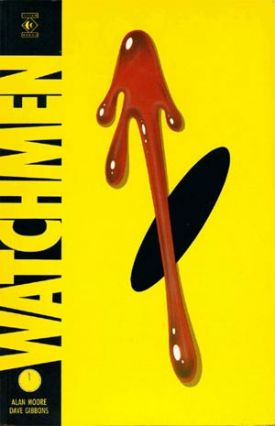
Watchmen into my hands. I was entranced by the book, reading the whole thing during a trip into the family home in Saskatchewan. There, in my grandparents’ den, in a chair that seemed built for perfect reading, I finished
The Watchmen, and laughed the Comedian’s last laugh. I still clearly remember the weight of the book on my lap as I stared into the distance, my brain still whirring with all of the data from the story I’d read, looping through the various threads built throughout the story. That was my first Moore Moment.
This story holds no surprise for anyone already familiar with Moore’s work; those people have had their own Moore Moments, and are probably considering their own. For those that haven’t, I’m jealous. I wish that every time I read Alan Moore, it would be for the first time. That way each time would have that heady sense of discovery and amazement, that hits you when you have been affected by a work of art unexpectedly.
Watchmen’s position as the penultimate Alan Moore work is no surprise to anyone, even before the press machine for the new film began grinding away. It’s personal and human characters, it’s layers and structure, and it’s adult storytelling, all within Dave Gibbon’s clear and detailed artwork, make it possibly still the most accessible introduction to the writer.
With all of it’s complexity and the deftness of how Alan handles the plot, it seems like the whole thing had to have been orchestrated before the first panel was drawn, like dominoes set into motion. The most fascinating part of the story of
Watchmen is how the creators themselves discovered the story, discovered the threads, only while creating... as though they were channeling the story instead of creating it on their own. “...about issue #3 when we suddenly noticed that something interesting was happening with the storyline.” 1 The magician Alan would later become could look back on
Watchmen and see this as an understandable event, where fiction takes on it’s own power. Alan’s earlier work showed the intelligence and deftness with comics that by themselves would have made him a great creator; they come together with the greatest power in Watchmen and ring out the most clearly.
From Hell was the next major work, though not the only project that Alan would be involved in. It was very much the next step, though. The technical craftsmanship of
Watchmen was present here, but instead of captivating you with the constant and intoxicating by-play between words and pictures, these techniques are done with subtlety and sublimation, they sit in the background and thrum underneath the story, giving it a power that might seem quieter than
Watchmen, but also deeper. A master of his craft, he now hides it away, hidden among the soot and history of Victorian London.
Since then he has continued to create fabulous stories of every stripe. His own love for superheroes crossed with the ability to represent normal humanity, even in abnormal realities, was showcased in Top Ten, a police drama where the police have to deal with a city where everyone has a superpower.
His love for ideas and adventure found their strongest voice in
Tom Strong, a science-hero in the mold of Doc Savage where intoxicating ideas about alternate realities or modular computing are blended with an exploration into the sort of adventure pulp fiction that gave birth to the earliest comic-book stories.
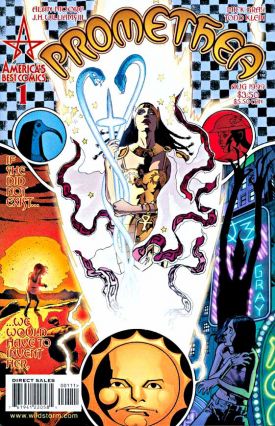
Promethea began as a mystical superhero adventure, but quickly became a method for Alan to coalesce a magical way of thinking. Many found this to be less involving than the adventure story from before, but even still, the fact that he spent more than half of the comic’s run explicating the Western magical tradition is a feat that must be respected.
Even Alan’s magical status is owed to his writing; in
From Hell, the character Gull makes the statement, “The one place Gods inarguably exist is in our minds where they are real beyond refute, in all their grandeur and monstrosity.” 2 Alan has stated that this stuck him after writing the line, that he couldn’t refute the point himself. In his own words: “Having written that and been unable to find an angle from which it wasn’t true, I was forced to either ignore its implications or change most of my thinking to fit around this new information.” 3 Alan’s own creation had convinced him of a unique truth regarding our reality, a fictional character inspiring a real response.
Alan’s intelligence and ability meant that if he professed this new sort of mystical faith, the readership could assume he knew what he was doing. In some cases, the readership wanted to follow Alan’s work with even more fervor than before. We were fascinated to see what the intelligence behind
Watchmen,
From Hell, and the rest would bring to the this new subject. We were not disappointed. Poetry performances that have been described as transformative have come from his declaration of magical study, not to mention the stunning work on the previously mentioned
Promethea. His upcoming book from Top Shelf,
The Moon and Serpent Bumper Book of Magic, sounds like it’s going to be give us not just an introduction into the concepts, but a workable system in the guise of the sort of rainy-day activity books from Moore’s own youth.
This whole list of Alan’s different titles and their virtues is necessarily incomplete; there is a host of other stories and ideas that haven’t been touched on. The man has been densely prolific both before and after the works described here, and even some of my own favorites can only get a mention among the breadth of his work.
V for Vendetta has a power that even it’s dated politics and future can’t weaken. The updated and less-subtle film was loved by those who never read the original; the faithful lamented that despite it’s quality, it could have been so much more. His work on Swamp Thing was continuously inventive and amazing, while also being legitimately terrifying.
Miracleman (or
Marvelman, depending on the publisher) took the notion of the superhero to it’s farthest point, where the benevolent protectors actually help elevate everyone to their level.
I hope that this essay begins to explain the level of fascination that Moore holds for so many people, and encourages them to dive into it themselves. Each work touched on could itself be discussed deeply, and they each merit that sort of attention. Having since begun to create my own comics, Alan’s virtuoso craft has been my main attention here, but this whole article could be re-written on the basis of the truth and humanity of his characters. From the pathos of Dan Drieberg in
Watchmen to the honest love in
Swamp Thing to the heartfelt honest amazement of it all in
Promethea, beyond the craft of sequential art, is the almost Shakespearean breadth of characters, who each behave in a way that you believe, laugh with, and sometimes cry over.
Earlier, I spoke about being jealous of a first-time Moore reader, having that thrill of discovery. In the process of writing this, I’ve discovered that the thrill is always there. Every time I go back to any of his best works, or when something new is released, I have another Moore Moment. I’ll set aside some time and a comfortable chair, and either find that magic touch in a new work, or find it again, but different, in a work I thought I knew so well.
Bibliography:
1 -
The Extraordinary Works of Alan Moore - by George Khoury and friends. (Besides tributes to Alan, the book consists of long interviews between Alan and George.) TwoMorrows Publishing, 2003
2 -
From Hell - Alan Moore and Eddie Campbell, Top Shelf Comics, 2008
3 -
Eddie Campbell’s Egomania #2 - an interview between Alan Moore and Eddie Campbell, Antelope Pineapple Pty Ltd, 2002
Last Updated: July 2, 2026 - 07:01
 ComicBookBin