
The Fairer Sex: A Tale of Shades and Angels, Vol. 2
By Leroy Douresseaux
March 31, 2006 - 16:50
Candle Light Press
Writer(s): John Ira Thomas
Penciller(s): Jeremy Smith
Cover Artist(s): Jeremy Smith
ISBN: 0-9766053-2-5
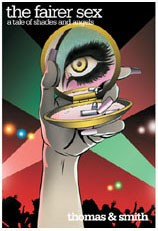
In the first volume of THE FAIRER SEX: A TALE OF SHADES AND ANGELS, a murderous costumed vigilante, The Madonna, went on a shooting spree in a shopping mall. Every one of her victims was male, and each one had at least an instance of abuse of women in his past. The Madonna’s homicidal extravaganza was also seemingly a call for another costumed vigilante, The Night Angel, to pay attention to her, and somewhere lurking around the edges was the de factor boogeyman of the Freedom City, Texas, the Fearsome Shade. The police detectives of Freedom City, Texas are caught somewhere in the middle of this.
A year later, we get The Fairer Sex, Vol. 2, the middle of what appears to be a glorious trilogy that’s going to say something big about the relationships between boys and girls. The brave cops of Freedom City are still trying to learn the who, what, and why of The Madonna. Meanwhile, The Night Angel turns to the suave and charismatic Johnny Mycenae the Introducer, a man who can apparently find people and just as well as he can find out about them. Mycenae is a talkative fellow, and might be the first great American equivalent of DC Comics’ John Constantine. Once again, caught in the middle are the detectives of Freedom City – ordinary Joes who really believe in doing their jobs. The job is about to get complicated as The Madonna plans on doing her killer thing again, but this time with a twist that throws the proverbial monkey wrench into the investigation.
If Frank Miller’s The Dark Knight Returns and Alan Moore and Dave Gibbons The Watchmen were a kind of glimpse into what superheroes in the real world would be like, Brian Michael Bendis and Mike Oeming’s Powers gave us a view that was closer to reality. Powers and Moore and Zander Cannon’s Top Ten also gave a nice spin on cops and super heroes, but the police of Powers and Top Ten, like the worlds of Miller’s DKR and The Watchmen are firmly grounded in superhero fantasy
John Ira Thomas and Jeremy Smith’s A Tale of Shades and Angels series belongs in exactly the same class of praise as the aforementioned quartet. However, Thomas and Smith have firmly taken the side of the cops rather than those with fantastic powers. One can compare these policemen and detectives to the spate of gritty TV cop dramas that followed “Hill Street Blues,” but the law in Shades and Angels is more “Homicide,” NYPD Blue,” and “Law & Order” than it is “CSI” and “Criminal Minds.” These police detectives aren’t glamorous super cops. They have the kind of familial, personal, and professional complications that make gritty, street level cop fiction so… alluring to viewers and readers.
While I listed many comics and television shows to describe Thomas and Smith’s work, one thing that I must not neglect to mention is that Thomas and Smith’s work is every bit as good as the works I’ve mentioned. That may be hard for some to believe because the duo (and their partner Carter Allen) labor in obscurity, but it’s time that the light in Candle Light Press no longer be hidden behind a bush.
Thomas has mastered a naturalistic kind of dialogue in which the characters really talk to one other. That’s risky for American entertainment where in which the characters, especially in TV, film, and comics really just talk at each other with the writers trying to make every bit of dialogue snappy and every line witty, snarky, and/or sarcastic. Thomas’ approach is like serious prose fiction in which what the characters say must not only contribute to their characterization, but also to plot, setting, mood, and action – as much or more so as the prose exposition. It’s a bold move when so many readers are diabetic on smart aleck characters being smart-assed. Thomas is already ahead of the curve than most small press and indie writers.
Like his partner, Jeremy has left most non-DC artists who draw superhero and fantasy behind him, and he’s currently in big boy land. He combines Will Eisner’s cinematic stylings, Neal Adams page layouts and panel designs, and Steve Rude’s fluid line. Characters, clothes, and sets morph across the page, merging with each other, creating a flowing narrative that gracefully carries the reader through the tale. I’ve always wanted to see Smith’s work in color, but the sparkling lighting effects he uses in his black and white art create the kind of film-noir-ish atmosphere that would make Val Lewton proud. So I don’t necessarily need to see his work colored.
The Fairer Sex, Vol. 2 is already an early entry into the “year’s best” sweepstakes, and it’s time more people discovered A Tale of Shades and Angels, so visit candlelightpress.com
Related Articles:
The Fairer Sex: A Tale of Shades and Angels, Vol. 2
Numbers: A Tale of Shades and Angels