Movies /
Home Theatre
Capote
By
Al Kratina
March 21, 2006 - 20:14
|
| So good it will make your eardrums bleed. |
Genres: Drama / Bio Pic
Your ability to enjoy
Capote may depend entirely upon your tolerance for character-driven drama, your patience for crawling narrative pace, and your capability to listen to either nails on a chalkboard or two Styrofoam takeout containers being rubbed against each other. If you can stand any or all of the above, you’ll probably appreciate what
Capote has to offer. If not, then you may have to pass on what you’ll no doubt find an achingly slow character study of a man who sounds like Jennifer Tilly’s younger, gayer brother. When helium gets high on helium, it sounds like Truman Capote.
The best part about
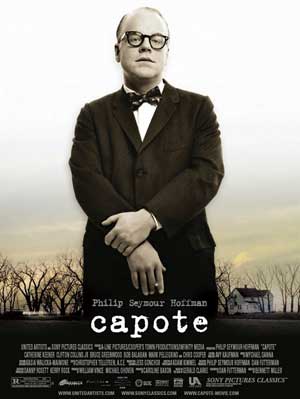
Capote is not Philip Seymour Hoffman’s performance, as most critics would have you believe. It is brilliant, to be sure, especially in the way he manages to toe the line between imitation and mockery with a grace that belies the fact that he looks like cookie dough. What I find most refreshing, however, is the way the film approaches the tried and true bio-pic format. Based, of course, on the life of Truman Capote, the film succeeds because it tells a story
from its subject’s life, as opposed to turning its subject’s life into a story. It’s a subtle distinction, like a misplaced Dewey decimal point, but it’s the difference between filing the film in with the high dramas as opposed to stuffing it in with the Coles Notes.
Specifically, the film recounts the period in Truman Capote’s life in which he wrote his seminal work, the non-fiction novel
In Cold Blood. By studying this event, we get a feel for Capote’s character and a sense of his place in history, without getting bogged down in the mundane details of his life. In 1959, Capote became fascinated with a murder case in small-town Halcomb, Kansas. While researching the story, Capote became familiar not only with the murderers, but with the whole town itself, despite the fact that every time he conducted an interview windows would shatter and every dog in the town would come running. Eventually, the bond he formed with one of the murderers, Perry Smith, would mutate into something close to love, but while this relationship would provide the center of a lesser film, in
Capote the story revolves around the writer’s narcissistic obsession with himself, and his own legend.
Dan Futterman’s script, based upon Gerald Clarke’s novel, manages to show us both Capote’s genius and his flaws in equal measure, neither judging his actions nor excusing his behavior. Director Bennett Miller lets the performers play out the story, but not without providing a bleak, sedate background from them to act against. And while Hoffman’s performance may get all the attention and bring home all the awards, it’s the material that he’s given to work with that’s the real star of the show.
Last Updated: November 29, 2025 - 16:51
 ComicBookBin