Comics /
Cult Favorite
It Pays to Advertise
By
Philip Schweier
February 28, 2007 - 08:15
Recently I was doing research for another story, and was getting into some old comics from the early 1970s. It had been a while since I’d revisited that particular era, and as much fun as the comics themselves were, what I enjoyed just as much was the advertising.
For instance, everyone I’m sure remembers sea monkeys. The illustration suggested idyllic families of sea creatures that would hatch before your very eyes. However, a friend of mine actually did get some, and what he ended up with was a bowl full of tiny shrimp-like creatures.
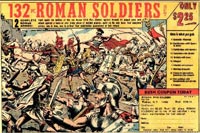
Another classic of comic book advertising were the armies of soldiers from every era. These ads ran for close to 30 years, and the price barely crept up, staying well under $5. (Fun fact: the 132-piece set of Roman soldiers was illustrated by comic artist Russ Heath.) But not just legions of Roman soldiers, you could get Medieval knights, Civil War era battalions, or modern platoons packed in a durable footlocker-style case.
Many of the toy soldier sets offered proved to be disappointing. After weeks of waiting for them to arrive, the package was often opened to discover they were much smaller and far less detailed than one was led to believe. Unfortunately, such is the tactic of some of the companies advertising their cheap wares to children. They rely on the kid not being willing to kick up much of a fuss.
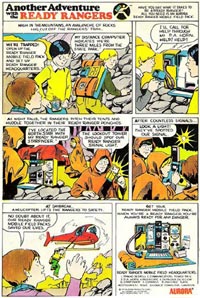
Toys were always a staple of comic book advertising, hawking everything from Schwinn bikes to Daisy BB guns. Both made it clear that with great gifts come great responsibility. My personal wish was for a Ready Ranger mobile field headquarters from Aurora, hoping to receive one each Christmas long after the ads disappeared from comics.
Some merchandise featured celebrity advertising. Dallas Cowboys
quarterback Roger Staubach endorsed Skittle-Bowl, while O.J. Simpson (whatever happened to that guy?) shilled for Dingo Boots. Apparently this was before he discovered Bruno Mali. Rick Barry and Dr. J(ulius Irving) made Spaulding a household name long before Tom Hanks got
Lost in an ad illustrated by cartoonist Jack Davis.
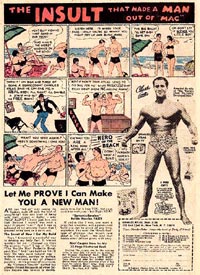
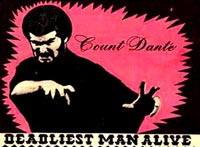
Physical fitness was a hot-ticket item. Charles Atlas was making a man out of “Mac” for years before I learned to read. How many comic readers he helped, who can say. In the early 1970s, everyone was kung-fu fighting, and guys like Count Dante (“deadliest man alive”) were eager to sell their training methods to any comic reader who came along.
Legitimacy was always in question. In
retrospect, prices were too cheap for the product being sold to have too much value. Some, like the body building courses, were dependent on the customer’s participation. Others I’m sure were only barely legal.
Another classic were the pages of tiny type advertising a host of novelty items, such as x-ray glasses, hot pepper gum, disguise kits, miniature cameras, trick safes disguised as books, magic cards, and secret agent spy scopes. Anyone wanting to be James Bond had all they needed right between pages of
Strange Sports Stories.
But how does your average kid with a limited allowance afford all these wonderful gimmicks, when they’ve already spent what little money they had on comic books? I’m glad you asked: You can sell
Grit in your spare time.
Grit was a newspaper, sort of a supermarket tabloid for the less gullible. It didn’t print actual news, but more feature material you’re likely to find in your average shopper in Collinsville, Illinois. You could also sell seeds from the America Seed Company of Lancaster, Pennsylvania, winning valuable prizes to boot. Sell enough like Scott Bloom of Washington did, and you may win a croquet set, a cassette tape recorder, or a basketball hoop.
And certainly let us not forget the house ads, for upcoming comics from DC. They were effective...eventually. One house ad I saw several times featured
Superman #272. It seemed to be in just about every comic I bought back then. Two years ago, I stumbled across that comic at a convention and picked it up. So, yes, the ads work...30 years later.
Marvel had its own house advertising in the form of Bullpen Bulletins. It featured Stan’s Soapbox, a checklist of this month’s titles, and other news items from the House of Ideas. It was a must-read for anyone collecting Marvel stamps.
From Hot Wheels™, to DC super-hero stickers, comic advertising has come a long way. Today it consists of mostly movies, public service announcements – “Tobacco is whacko” – and video games. Unfortunately, they’re not likely to be as memorable as the comics they’re featured in. •
Praise and adulation? Scorn and ridicule? E-mail me at philip@comicbookbin.com.
Last Updated: November 29, 2025 - 16:51
 ComicBookBin