Comics /
Comics News
The 99 – Buying Yourself Influence, Prestige and Power through Comic Books
By
Hervé St-Louis
October 14, 2011 - 01:52
For several years, a comic book series / imprint has captured the imagination of the world through its stated mission of cultural mission of openness and apparent will to foster dialogue between civilizations.
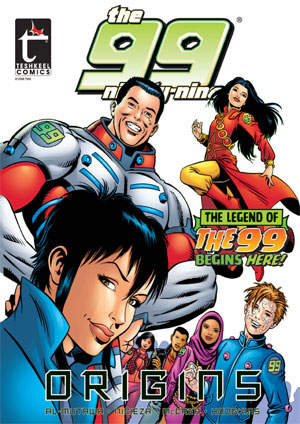
The 99 is a product of Teshkeel Media Group started in 2004. The concept of the 99 comic book series is that of Muslim-based comic book super hero role models for Muslim kids and other cultures. The 99 has been backed by very powerful allies and been talked about by President Obama; its creators and supporters have been invited several times at TED talks; the 99 has been featured in
The New York Times,
The Washington Post,
Radio-Canada,
Al Jazeera, the
BBC and many other prestigious publications and television stations across the world. Even
The Comic Book Bin has published featured articles about them, although they did not go through the publisher, because I would have blocked their effort, since I see no merit in their work. And that’s where the problems and the questions surrounding the real purpose of the 99 start. No single comic book publisher has had such success doing the public relations round and being talked about while publishing little that the average comic book reader and the intended demographic group, kids from across the world, care about.
What is the real purpose of the 99 and why does it receives so much backing from the gatekeepers of the world? Why is there such unduly attention on a publisher whose comic books cannot even be purchased easily at the local comic book store, whose sales numbers seem doubtful, whose influence in the world of comic books is minimal, whose characters this publisher cannot name, and whose stories have failed to capture the imagination of the average comic book reader, including the Muslim kids that it targets? What’s the deal with the 99? The only 99-related comic book I have seen in a comic book store was an inter-company crossover with DC Comics. Was DC Comics paid to give props and legitimacy to a comic book series that has only about 28 issues published so far, in the eight years it’s been around because of its powerful promoters?
As a student of comic book history, political science and public relations, I see a definite problem with the 99 and how much influence the series and its creators have garnered over the years for producing so little that matters and that has actually being read by the intended audience. It seems that more world leaders have read about the 99 than 14 years-old boys who collect comic books. For example, what does the 99 have to say about Shia Islam versus Sunnite Islam and the relationships between both sides and the non Muslim world?
The story of the 99, when interviewed and featured in a media story is always the same. It’s about a comic book with based on an international cast of characters from all cultures and religions that are tolerant and open to other cultures. The themes are about inclusiveness and the new face of Islam. Every article published gives props to series creator Doctor Naif Al-Mutawa. There is little information about ongoing stories, the reaction of comic book readers and kids to the comic book series and actual results achieved that can be measured independently. Instead, the stories are always about the progressive nature of the 99, its creator and the potential for cultural outreach the series has. It’s always about potential, not actual results.
There have been tons of comic book publishers and creators that have created comic books with far more cultural outreach and actual results than the 99. Even large publishers have done more featuring ethnic, gender and religious minorities in comic books than the 99, yet none of them has ever had as much publicity. More effort seems to be put on the public relations aspect of the 99 project than the actual comic book which is severely limited in terms of physical distribution. The creators that work on the 99 are mostly Westerners which are established comic book freelancers in the comic book industry. Writers and artists like Fabian Nicieza, Stuart Moore, Ron Wagner, Sean Parsons, Dan Panosian and John McCrea are well known for their abilities to respect deadlines but are rarely the stars of all the media accolades received by the 99. Instead, it’s the series creator, Al-Mutawa, without any real credits in comic books outside of the 99 that gets all the props.
When it began its operations, Teshkeel Media Group approached The Comic Book Bin, but beyond the odd press release, I largely ignored them because of the way I felt they manipulated the media in their quest to show a more progressive view of Islam. Then, they got original stories through one of the writers of the Bin, which as is our policy, are free to post stories of their choice. It’s interesting that they never deemed it necessary to pitch their stories to me. Getting your foot through the door, without approaching editors and publishers, is a technique seasoned public relations professionals use. The publicist will work hard to get that one writer to write a story that can be included in the publication they work for, while by-passing the embedded scepticism of the editors and publishers.
The real question about all this media manipulation is what exactly does Teshkeel Media Group wants to achieve? What is their objective? Is the 99 simply a pastime for Al-Mutawa to buy himself and his rich backers awards and accolades for their “humanitarian” and progressive work? The 99 has already garnered Al-Mutawa a UNESCO prize for children literature for publishing what I would consider 28 issues of a comic book nobody reads or care about, down in the comic book trenches. It used to be that awards and accolades were given to comic book creators that really did groundbreaking work, like Art Spiegelman’s Maus or Marjane Satrapi’s Persepolis. Now, a comic book which has had little influence, little critical literary acclaim, and little readership gets major accolade from the world’s media and several influential organizations such as TED and UNESCO just because it features Muslims in a Post 911 world. Often, it feels like stories are written about the 99 as some kind of white-liberal guilt trip to show a positive spin on Islam by Western media.
An animated series for the 99 is in the works. It will be interesting to see how much influence the 99’s backers can use to get broadcasters to feature its television series across the world. There are things that money cannot buy after all, especially if advertisers are not interested in buying ads for a cartoon series that no one really cares about. Perhaps the influence game Al-Mutawa and Teshkeel Media Group have been playing for years will hit a wall once they step out of the comic book world - that is unless they can buy their way in the world of animated broadcasting too.
Last Updated: July 2, 2026 - 07:01
 ComicBookBin