Movies /
Movie Reviews
Public Enemies
By
Andy Frisk
July 11, 2009 - 18:37
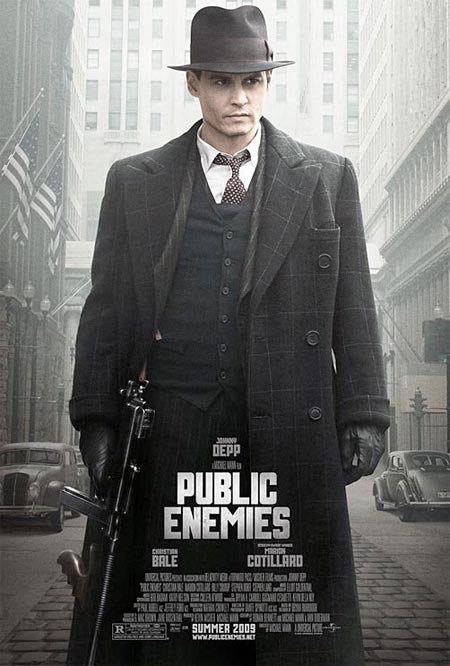
“Die like you live: all of the sudden,” was Clark Gable’s famous line at the end of Manhattan Mayhem, the Depression Era gangster film which John Dillinger (Johnny Depp) watches just before meeting his fate at the end of Michael Mann’s gangster film, Public Enemies. It seems that life inspires art in the movies as much as in real life. The Tommy Gun brandishing, bank robbing, and fast living gangsters like Dillinger, George “Baby Face” Nelson, “Pretty Boy” Floyd, and their like inspired many films, some of them art, some not. Happily, Public Enemies is much more a work of art than not.
Mann’s film interprets Bryan Burrough’s 2004 non-fiction book, Public Enemies:
America’s Greatest Crime Wave and the Birth of the FBI, 1933-34. Although artistic license is taken, Mann delivers a film that communicates, with his signature style and excellent direction, the heart and soul of Dillinger’s story, and all its folk hero glory. Mann covers most members of Dillinger’s gang, as well as some other gangsters, most prominently of which is George “Baby Face” Nelson (Stephen Graham). The real focus though, is Depp’s Dillinger, and to a lesser extent, Melvin Purvis (Christian Bale), the FBI Special Agent in Charge,
Chicago, who is tasked with bringing Dillinger down.
As the film opens, Dillinger, ever the man to live “all of the sudden,” breaks his partners out of jail, then takes Chicago, and Billie Frechette (Marion Cotillard), his “new girl,” by storm. If he wants something, be it a bank’s cash holdings or a beautiful woman, he simply takes it, charming all involved along the way, and garnishing for himself a folk hero reputation (banks were seen as run by greedy profiteers profiting from the common man’s strife during the Great Depression, and Dillinger either refused or gave back the bank customers’ personal money). Dillinger is the perfect picture of the anti-hero gangster. He is revered by his public (and by default the movie watcher), and lives the life of ultimate freedom. He also lives fast, and will assuredly die young leaving a beautiful corpse. He inspires the men to “stick it to the man,” and charms all the ladies along the way. When he finally meets his demise it will be because of his own tragic flaw, be it hubris or whatever. In short, Depp’s Dillinger will be everything we’ve seen before, and as a result be utterly boring. It’s great to see, as the film progresses, that this isn’t completely the case.
His life, which is lived “all of the sudden,” and his philosophy for never thinking past tomorrow do not do him in. They do not serve as the tragic flaws which bring him down. No, it is the progression of technology which ultimately leads to his downfall. As Frank Nitti’s Crime Syndicate of Chicago goes more and more high tech, using telephones to fix races, and coordinate bookies nation wide, Dillinger and his bank robbing counterparts fall out of favor with Nitti (Bill Camp) and his Syndicate (Frank Nitti being Al Capone’s successor to the Chicago crime empire). Nitti’s bookies can make more a minute than Dillinger and his men can make in one bank job. Suddenly cut off from all
Chicago mob safe houses and contacts, as he and his gang are a magnet for cops, Dillinger finds himself a man out of time, not in the literal, but figurative sense of the word. His time is ending. He truly is a smarter, more charming, and capable man than his pursuers, with the only possible exception being Purvis. If Dillinger has a flaw, it is that he is the best of a dying breed of American wild-west type bandits whose times are ending, and definitely not hubris. Confidence in ones abilities isn’t hubris if ones' abilities are that good, and Dillinger's are.
Depp and Bale square off as the gangster verses the G-Man, but spend relatively little screen time together. They really only have one conversation, much like Pacino and DeNiro did in Mann’s masterpiece, Heat. While Depp and Bale aren’t on Pacino and DeNiro’s legendary level as actors yet, they are both approaching rapidly, with Depp nearly there, and Bale not far behind in master actor status. Mann’s direction is more of the same, and this time out that’s not a bad thing. Mann’s penchant for style, authenticity, and excellently filmed shootouts are all present. His other penchant for slightly drawn out scenes, which sometimes fails miserably, (like in Miami Vice) works well here (like in Heat). Acting performances all around are solid, with even Stephen Dorff’s performance managing to be bearable this time out.
Overall, Public Enemies is time well spent, and continues to showcase Johnny Depp’s depth of acting ability. Yes, he’ll probably always suffer from the “heart throb” label, my fiancé, who cares nothing for Michael Mann’s films, and even less for 1930’s era gangsters, readily agreed to see the film with me simply “because Johnny Depp is in it.” As time progresses, and he continues to demonstrate the range of his ability, which stretches all the way from deranged pirate, to weird chocolatier, to badass gangster with heart, it won’t be long before he becomes the lead actor of his generation.
Rating: 9 /
10
Last Updated: November 29, 2025 - 16:51
 ComicBookBin