Comics /
Comics News
Should Canada Have a Comic Book Industry Policy?
By
Hervé St-Louis
October 11, 2008 - 00:02
|
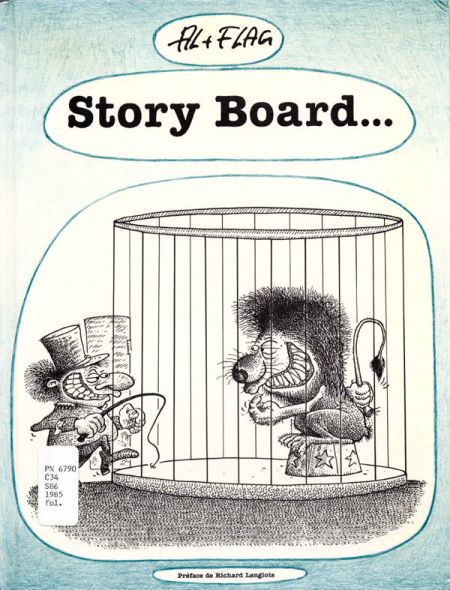
| Art and text by Al+Flag
Cover: Story Board … . Montréal-Nord: Michel, 1985. 48 pages
Source: Story board
Al+Flag. -- Montréal-Nord : Éditions Michel, 1985. -- 48 p. : en majeure ptie ill. ; 29 cm. -- ISBN 2980048100. -- Oeuvre complète
© Al+Flag. |
The question may seem ludicrous to many, but to this author, the question is a serious as asking if Canada should have a film industry policy, a video game industry policy, or a cartoon animation policy. When it comes to its film, video game and cartoon animation industry, Canada has a define policy about how it seeks to promote these industries in Canada and abroad through various means and to various ends. If one takes comic book production seriously, then the same question is no longer an oxymoron or wishful thinking.
When it comes to cinema and television, the Canadian Government and most provinces have a clear plan of action to promote Canadian culture through film and broadcast airwaves. The second purpose of its policy is to aid in the job creation in the field of cultural industries. Job creation is the main goal of the policies aimed at the video game and the animation industries in Canada. Hence, various tax credit measures and arts funding programs have been created mainly by the Heritage Department of the Canadian Government to promote film, video games and the cartoon animation industries. It can be argued that the strategies used to achieve the policy of promoting Canadian culture and job creation are not always fine-tuned or effective, but there is a defined will by the Canadian Government and its provincial counterpart to do something. The same cannot be said about the comic book industry.
Currently, what passes for a comic book industry in Canada, through the eyes of policy makers and bureaucrats, is but a part of the book and magazine publishing industries. There is no specific policy addressed specifically to the comic book industry in Canada.
Do comic books warrant a special attention from governments in Canada? Of course they do. Comic books are the forerunner of what is considered multimedia arts. Comic books combine many disciplines and can achieve many cultural promotion purpose at cheaper cost to the creators and the Canadian taxpayer than other art forms. If a Government seeks to promote its culture abroad in a universal language based on visual information, easily replicable and reproducible, and accessible to a mass market, there is nothing better than a comic book.
|
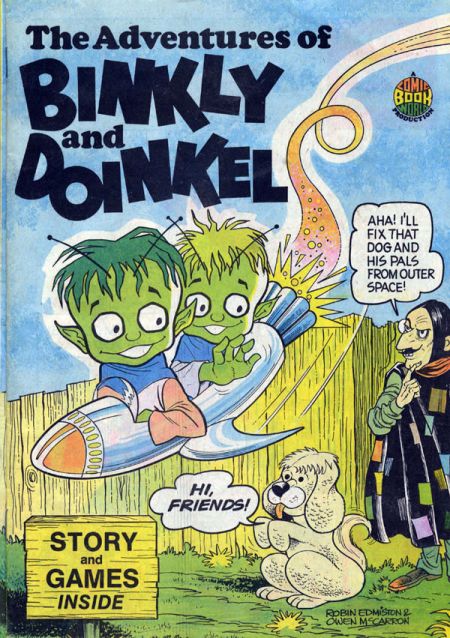
| Cover of Binkly and Doinkel, (1981). Art by Owen McCarron
Source: The adventures of Blinkly and Doinkel
[Ottawa] : Consumer and corporate affairs, 1981. -- 14 p. -- ISBN 0662118219. -- Cover
© Industry Canada |
Comic books, better known to English-language scholars as sequential art, is a visual medium where a sequence of images assembled spatially convey a narrative message through the sequence of visual captions. To these images, texts and story meaning can be added. Although they are older than the written language, comic books have been used mostly since the 20th century to inform and entertain the public at a minimal cost, effectively.
A policy supporting comic books cannot, for example, be enacted as a job creation attempt, as in the film, video game, and animation industries that hire hundreds, if not thousands of crews for a single project. Comic books are more like books in that a relatively small team of creators and support staff at a publisher can produce a title that can be exported and read throughout the world for a fraction of the time and money a film or a video game, can, but with as much potential reach, thanks to its visual strength and language.
The question remains, what does the Canadian Government has to promote about Canada, that it must rely on comic books rather than other media? This, I believe is the real policy question while comic book publishing is but the strategy to send a message out there. I have argued that culture is a way for a country to score points on the international scene and generate a positive image about itself abroad. For example, comic books created by Disney, in past decades, it was argued promoted American capitalism throughout Latin America. Of course, Government should let artists create at arm’s length and just generate a critical mass of comic books that lend themselves to be distributed and read by readers all over the world.
From a pure art standpoint, comic books are popular with many people and do not age as fast as other form of art. Today’s readers can easily immerse themselves in the body of work of past generation of comic books that entertained older generations. Only animation has a similar staying power.
Canada is a bilingual country, French and English with a modern society welcoming people from the world and integrating deeply into the Canadian world. Canadians respect the rule of law and a free market society. Canada is one of the only countries of the world with a multicultural makeup and two official languages. Yet, Canadian society can teach a lot to the world about how a modern and dynamic country can exist and provide multiple opportunities to its citizens.
|
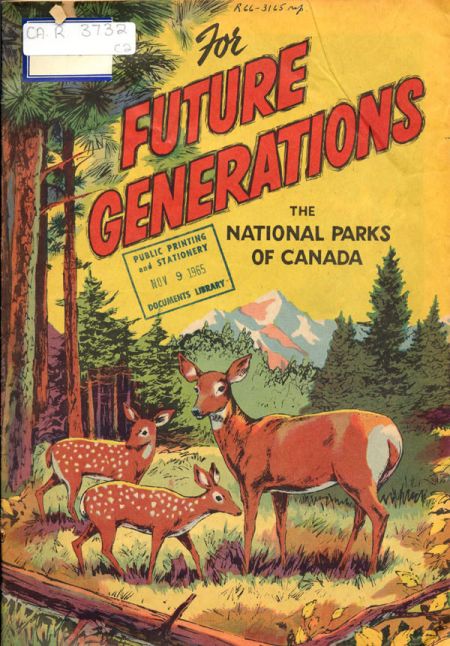
| Cover of comic book, FOR FUTURE GENERATIONS: THE NATIONAL PARKS OF CANADA Cover of For Future Generations: The National Parks of Canada, (1965). Art by Ganes Studios
Source: For future generations, the National Parks of Canada
Ottawa : Roger Duhamel, Queen's Printer, 1965. -- 16 p. : ill. -- Entire work
© Parks Canada. |
If we agree that Canada should have a distinctive policy for its comic book industry, then the next question is what strategy to must use to enact its policy? Should the Canadian Government and provinces be actively supporting the comic book industry through grants, loans, tax credits, or help for representation abroad? Should for example, a special push be made to create comic books for special groups like children and aboriginal Canadians? In the book world, most type of literature is supported, but material such as cookbooks and travel material are not supported to the same extent as fiction. In the film and broadcast world, the government does not support pornography, reality television, and game shows. In animation, because most of the contents are geared towards children, there are stricter guidelines and requests for clear overt Canadian contents in the works. In video games, there doesn’t seem to be any oversight over the contents of the products, probably because the job creation aspect is the ultimate objective of the government as opposed to the promotion of Canadian culture.
There are many genres of comic books touching very different target markets, no sound support strategy can be generated without first understanding what it is one seeks to promote. In hindsight, perhaps Canadian comic book readers should take their local industry more seriously and start asking themselves what kind of comic books they would like their fellow Canadians to create.
Last Updated: July 2, 2026 - 07:01
 ComicBookBin