|
|

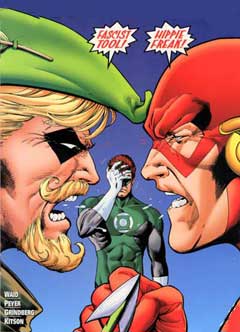 |
Another example is a moment in a Brightest Day #7, in which conservative Hank Hall destroys a jukebox playing a Dixie Chicks song. This is a reference to a negative comment made in 2003 by Natalie Maines of the Dixie Chicks about then-U.S. president George W. Bush. According to Wagner, Hank Hall is depicted as the “team jackass” with no regard for personal property. I agree such negative portrayals are out of place and only convey a liberal bias that may or may not exist.
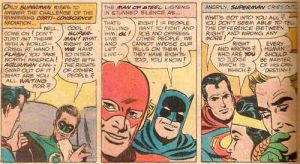
Wagner refers to super-heroes as being apolitical, but I disagree. Instead, they exemplify moral righteousness by the way they enforce their own brand of justice. But it’s difficult to determine which side of the political aisle they may be on. Defying authority and operating (usually) outside the law could be seen as a liberal trait, but doing so to enforce their world view of what is right and what is wrong might be perceived as more conservative.
 |
But I do agree that often, writers will use their stories as a means of expressing in some small way their own personal beliefs, which can alienate a significant portion of their intended audience. Many comic book writers have some particular ax to grind and constantly use their stories as a means to beat readers over the head with it. The danger there is twofold: the message is repeated so often it loses any meaning, and readers lose interest in the story.
Realistically, politics have crept into writing ever since the first caveman scrawled on a wall with a dirty stick. However, artists and writers have an obligation to their audience to depict political views accurately.
 |
True enough. It’s not as if the employees of a U.S. Department of Defense contractor are huddled over workbenches connecting sticks of dynamite to alarm clocks and shipping them overseas.
This story has a personal viewpoint for me because my father was an electrical engineer employed by the U.S. Air Force for several years, assessing and evaluating various electronic systems and components. Never once did I feel he was creating weapons designed to kill. In my eyes, he worked for the Department of Defense, putting his knowledge to use in the defense of our nation.
I’m sure I’m not the only family member of a soldier who feels this way. In the case of the woman from the Captain America story, my concern is not her politics, but in the nature of her written character. I believe a more realistic portrayal would be her appreciation that her husband has a full-time job with a government contractor, which translates into job security and good benefits. Do the employees of gun manufacturers or cigarette makers question the moral aspects of their jobs? I think not.
Granted, if armed men took my parents hostage due to my father’s job, I might not be so complacent, but I wouldn’t blame my dad’s employer. I’d blame the men with the guns for making war on non-combatants.
I won’t begrudge anyone their own politics, but I do believe there is a time and a place for expressing one’s views. In my opinion, using a comic book character as a mouthpiece is only appropriate when it is consistent with the character in question. I challenge today’s comic book writers to portray their characters’ politics accurately. It is the writer’s responsibility, especially when said viewpoint is in opposition to the writer’s own.
Praise and adulation? Scorn and ridicule? E-mail me at philip@comicbookbin.com
© Copyright 2002-2026 by Toon Doctor Inc. - All rights Reserved. All other texts, images, characters and trademarks are copyright their respective owners. Use of material in this document (including reproduction, modification, distribution, electronic transmission or republication) without prior written permission is strictly prohibited.