|
|

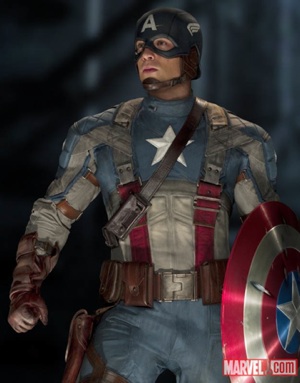 |
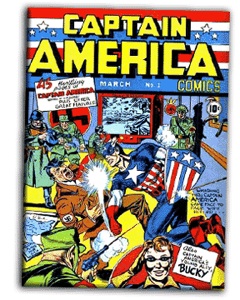
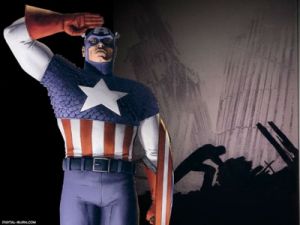
Cap is unlike many other super-heroes in many ways. For one, he is one the few characters from Marvel Comics that dates back to the 1940s. He was created by Joe Simon and Jack Kirby in the wake of a wave of patriotism stemming from the outbreak World War II. As such, he is less of a “crime fighter,” more of a “super-soldier.”
With a sub-title of “The First Avenger,” the movie may refer to the fact that he is the oldest character to be a member of the super-hero team, the Avengers, also soon to be a major motion picture. Otherwise, it begs the question of what was Captain America avenging in those days. Perhaps within the movie, his role is to seek retribution for the acts of the Axis powers: fascism, torture and genocide. But super-heroes are supposed to be above such damaging emotions, aren’t they? They’re supposed to struggle for the greater good, aren’t they?
A little history: On Dec. 7, 1941, “the United States of America was suddenly and deliberately attacked by naval and air forces of the empire of Japan.” Approximately four months later, the U.S returned the favor in a bombing raid led by Lt. Col. James Doolittle. Sixteen bombers struck at targets in Tokyo, Kobe, Yokohama, Osaka and Nagoya.
 |
The distinction between justice and vengeance is a very thin line, and often becomes blurry in the heat of emotion. This has been portrayed in film – a hero claims to be driven by the desire for justice, only to be scolded, usually by an ally of some sort, that what they really seek is revenge. Examples of this can be found in such genre movies as Batman Forever (1995) and Star Trek: First Contact (1996).
Personally, I have no problem with revenge as motivation. The desire for it can be perceived as an emotion, and as such it is a tool to be used, either positively or negatively. In 1941, seeking revenge on Japan for the bombing of Pearl Harbor was not so unhealthy. What would be unhealthy would be to inflict such pain and suffering on the innocents – noncombatants, if you will – of Japan.
To quote the British television program The Avengers: “Extraordinary crimes against the people, and the state, have be avenged by agents extraordinary.”
Which raises the question: Is such an idea really so terrible? Those that would perpetrate a crime should be hunted down and punished on the same scale as the crime itself. This may lead a nation to form elite special operations teams in an effort to efficiently mete out justice.
 One of the Black September terrorists at the 1972 Olympics in Munich |
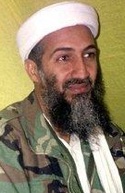
Last spring, after almost 10 years, the man who masterminded a frightening terrorist act against my country was finally neutralized. Many people around the world actively rejoiced, but one sound-byte from the nightly news questioned the merits of the desire for vengeance, saying it was not a noble sentiment.
How does one apply justice to a person who is accused of being responsible for the deaths of thousands of people? If one were to use the eye-for-an-eye philosophy, that only works once. Granted, there is the possibility of post-mortem violation (dismemberment, immolation, etc.), but that’s quite literally overkill.
Personally speaking, I would view the desire for vengeance as one of the many negative emotions, to be lumped in with jealousy, anger or hate. To have such emotions is natural and human, but perhaps how we feel is less important than how we act upon those feelings.
If we can regard emotions (positive or negative) as tools, negative emotions can sometimes fuel our ability to change things for the better. Is hating bigotry a bad thing? I don’t think so. Being angry at the injustices of the world can sometimes be the motivation to actively seek effective change.
 |
I won’t presume to speak for the any previous generations of soldiers, or even the current men and women in uniform. Nevertheless, I feel it is an unfair comparison. The events of Sept. 11, 2001 were not fueled by the government policies of aggressor nations, but by a radical fringe element stabbing at symbols of American economic power with total disregard for the cost in innocent human lives.
No government can permit such suffering to cloud its judgment, leading it down what is later seen to be a wrong path. The Japanese internment camps of the 1940s were wrong, as well as some of the reported treatment of prisoners at Guantanamo Bay in recent years. No doubt there are details to such events that I am not privvy, so I refuse to second-guess the decisions made by those in charge. Intentions may be noble and sound, but ultimately it is our actions we must answer for, not our thoughts or feelings.
In the past 60 years, mankind has evolved, hopefully for the better, into a more tolerant, open-minded being. Many of the bigotries and ignorance of the past have been abandoned in favor of a more enlightened perspective on our fellow citizens. Unfortunately, in some instances, this has shifted the responsibility for one’s actions to a dangerously tolerant viewpoint.
So if the desire for vengeance against Al Queda is something we feel, let us be honest with ourselves and others by accepting it as one of the many emotions we may feel throughout our lifetime. Yes, it makes us feel less righteous and less heroic, but such is the nature of being human.
Taking the high road is no way to defeat evil. If we are to pursue terrorism into the sewers in which it festers, we must be prepared to immerse ourselves in the brackish waters that spawned it, and slug it out amidst the filth and garbage in which it grows. Staying squeaky clean and pure is simply not an option if good is expected to triumph over evil.
Praise and adulation? Scorn and ridicule? E-mail me at philip@comicbookbin.com
 |
© Copyright 2002-2026 by Toon Doctor Inc. - All rights Reserved. All other texts, images, characters and trademarks are copyright their respective owners. Use of material in this document (including reproduction, modification, distribution, electronic transmission or republication) without prior written permission is strictly prohibited.