|
|

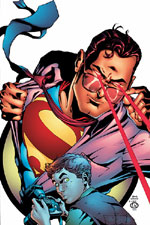 |
Hmmm. It’s a tie-in to Countdown. That’s disappointing. I hate it when they link an ongoing title into a mini-series that I may not be reading. Oh well, it will make sense when I pick up the trade, I guess. It’s the origin of Jimmy Olsen’s signal watch... again. But I must admit, the drunk Scottish robots is a nice touch.
7:40 a.m. Do I have time for another? Sure. I may be a few minutes late, but since I’m likely to work through lunch, what they hey?
 |
Lots of big panels in this one. Lots of internal monologue too. Remember when publishers use to use scalloped thought balloons? Apparently Kurt Busiek does, seeing as how he used them in Action #852. Kinda sad that I actually noticed them. It makes me realize how uncommon they are, like dialogue on a cover.
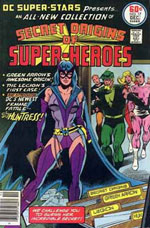
Well, that went quickly. Ollie finds a settlement, vomits up a fish, makes a
bow, finds a grave and gets attacked by an airplane.
And the time now is: 7:45.
Hu-wha?!
Twenty minutes to read one comic (98 total panels); five minutes to read another (70 total panels). The Lord loves infinite variety, and so do I, but I can’t help feeling that more panels means greater variety.
 |
Maybe it’s the editor, Mike Carlin, or Dan Didio. “Fill six issues so we can do a trade,” someone may have said. Or maybe DC could have done a double sized, prestige format book, thereby eliminating the production costs on a trade.
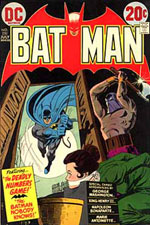 |
In fairness, that issue also featured seven paid ads between the covers, which undoubtedly helped defray the modest production costs. Back in 1973, artists were paid by the page, period. No incentives, no profit share, not even health insurance. They weren’t even given the art back. As far as the publishers were concerned, it was bought and paid for and belonged to them. It often went into a pile, only to be eventually dumped in a furnace somewhere.
But production is more complex these days, printing is more expensive and comic book creators these days usually negotiate a bigger share of the profits. This, of course, drives the price up. Nevertheless, as a consumer, I expect a bit more for my $2.99 than a five-minute read, consisting of 21 pages of story, five house ads, five paid ads, and a DC nation column.
I find fault with the creative teams. Many writers seem inclined to have several pages with very little dialogue. Artists often confine themselves to three or four panels per page, with minimal backgrounds. But it’s nothing new; it’s been going on for years, as creative teams have taken a more cinematic approach to storytelling, complete with voiceovers, extended camera angles and dramatic pauses.
It is my hope editors will encourage their freelancers to take a different approach, and challenge them to tell stories that are bursting with action, adventure and sound character development. Speaking for myself, I’d rather not see a whole issue go to waste as the hero journeys off somewhere to find himself in the aftermath of some failure. I expect more for my $2.99.
Which is why I’m waiting for the trade version of Countdown.
Praise and adulation? Scorn and ridicule? E-mail me at philip@comicbookbin.com
© Copyright 2002-2026 by Toon Doctor Inc. - All rights Reserved. All other texts, images, characters and trademarks are copyright their respective owners. Use of material in this document (including reproduction, modification, distribution, electronic transmission or republication) without prior written permission is strictly prohibited.