|
|

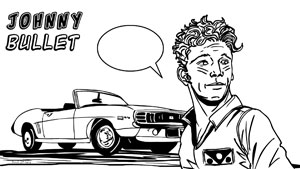
 Simon, of Silly Daddy |
In an era where e-mail, e-books, and e-commerce has all but replaced traditional ways of communicating and sharing thoughts and ideas for money, the world wide web has become a forum for creative people of all stripes to show their work, from writing to art to music.
Each year, The Savannah College of Art & Design’s sequential art department hosts Editor’s Day. A common topic addressed during each year’s forum is the Internet as an invaluable communication tool, and its effects on the comics industry in terms of marketing, submissions, and individual achievement.
“Like the rest of the web, there’s really good and really bad,” says Joey Cavalieri, an editor at DC Comics. “Like the web, when it’s good, it’s really good.” His recommendations include David Rees’ Get Your War On – “One of the funniest strips I’ve seen in a billion years, it’s just hilarious,” he says – and Derek Kim, who does Same Difference at lowbright.com. According to Cavalieri, “If you really want to see the future of comics, go there.”
 Get Your War On by David Rees |
The volume of material marketed through the Internet is staggering, from websites for best-selling authors to struggling novices looking to put their name in front of the right people. “In terms of trying to build your name with an audience, I think it's good to have a website,” says Jeremy Ross, editorial director at TOKYOPOP.
 |
“We're working with some people that do a web comic called Van Von Hunter. The fact that there's a lot of people who know it, that's good,” he says. “When we announced that book there were a bunch of people in the audience who screamed out, and we may have announced another book and nobody will know. So I think it's really good to try and get your work up there, get it noticed, get people commenting on it in the forums, generate some buzz, figure out if the right people like and if the right people don't like it, because you won't please everybody.”
Some may appreciate the ease of visiting websites, but Ross is quick to add that it has to be a good website. “If it's hard to view things, if the view is not smooth, if you have to scroll a lot, that's all bad.” Some times, a website won’t function properly, and take down a publisher’s server, which will not endear an aspiring creator to anyone in the company.
But in the submission of web comics, there is a right way, and a wrong way. For instance, sending attachments through email isn’t recommended. Editors prefer a URL, which will allow them the option of exploring your website.
“Holy mackerel, please, please, please don’t send me an attached file,” advised Cavalieri. “I’ve only got so much bandwidth and if someone sends me their paintings I’m not going anywhere for the rest of the day. Send me the URL. You can reach anybody by e-mail, and I’ll be more than happy to check it out.”
However, not every editor may be so eager to accept your invitation. “If I get an e-mail saying ‘Check out my website,’ you've got high-probability that I won't because I don't have the time,” explains Axel Alonzo, an editor at Marvel Comics. “It's probably more practical for you to slip something in an envelope because I will open it or my assistants will and if they like it they'll show me.”
Often, electronic submissions also are regarded as junk mail by e-mail system filters. “We get a variety of unsolicited e-mails a day that just get thrown into spam folders. You can't even count on it getting to an editor,” adds Alonzo. “But I wouldn't discourage you from having a website as an artist because if you got the time to organize it, it's another visual aid.”
Surfing the ‘net is a cheap and easy way for editors to locate potential new talent. Inviting them to visit your site allows them a chance to get an overview of your work on their own terms, rather than the mob atmosphere of some conventions.
Not only is an individual website a valuable self-promotional tool, so are many comics fans sites and news sites. Internet sites have become so important because they are the most timely news source there is.
 Chris Staros of Top Shelf Productions |
“If you send a copy to the Comic Journal for review, their review may be published three months after your book hits the market, so it has no effect on pre-orders for your book,” explained Chris Staros of Top Shelf Productions. “But the Internet reviewers, you can tell them ‘I need this review to go up on the 29th because that’s when the Previews catalogue hits,’ or a week before that so that people hear about your book before it’s even available for ordering. Then they see it in the catalogue and they read a good review and they try one.”
“With the Internet, there are so many people reviewing comics,” Staros added. Comic book fans are all to eager to provide free content to fan sites all over the web, sharing what they like best about their favorite comic. “Get them into their hands. For some it’s a cheap form of advertising. Some people check their sites every week to see what’s out.”
Staros cites Fourth Rail as an example. “When they started out all they reviewed were mainstream comic books,” he said. “We just kept sending to them and sending to them. There were books by us that they started out hating at the beginning, but by issue six they loved them.”
Praise and adulation? Scorn and ridicule? Email me at philip@comicbookbin.com
© Copyright 2002-2026 by Toon Doctor Inc. - All rights Reserved. All other texts, images, characters and trademarks are copyright their respective owners. Use of material in this document (including reproduction, modification, distribution, electronic transmission or republication) without prior written permission is strictly prohibited.