|
|


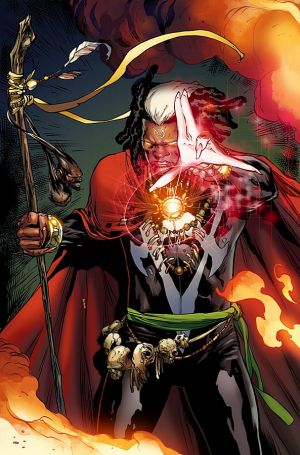 |
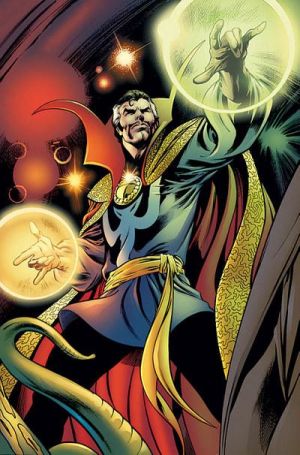
As an example: a Vampirella who is descended from Lilith (who, in some early Christian teachings, which aren’t canon now, was Adam’s first wife. She was expelled from Eden for enjoying sex too much, among other things, and became the mother of all the evil monsters in the world) is much more appealing than a Vampirella descended from the planet Drakulon, an extraterrestrial world where oceans are made of blood. Vampirella, as a character, is much darker, dangerous, charismatic, and realistic if she has a basis in a religious tradition that is practiced by many and more easily related to (even if her mother is part of a “heretical” tradition that’s full of feminist symbolism). By logical extension, Doctor Voodoo is more compelling and charismatic than Doctor Strange for the same reasons.
 |
Doctor Voodoo, being magically super-powered by voodoo, deals with loas, and refers to Bondye (a phonetic spelling of Bon Dieu, which means “good god” in English) and Papa Legba. Loas, Bondye, and Papa Legba are deities and religious figures from African religions practiced by slaves who blended them with elements of the Catholicism practiced by their colonial masters in Caribbean nations such as Haiti, thus creating voodoo (a blanket term which consists of Haitian Vodou, Louisiana Voodoo, and West African Vodun). This was done by the slaves because the plantation owners discouraged the practice of their cultural religions. By blending elements of Catholicism with their original beliefs, they were able to continue their religious practices under a lessened threat of persecution. It is a religion birthed of the slave culture of the Caribbean and Southeastern United States, and is still practiced today. Doctor Voodoo is a fictionalization of a real life religion and culture. Doctor Voodoo thusly is the perfect vehicle for some interesting storylines. He has thematic ties to a religion that is culturally, socially, and politically relevant to an understanding of a culture that recently suffered huge disasters of heart rending proportions (New Orleans and Haiti, to a much greater degree). Doctor Voodoo, as a culturally diverse super hero (compared to most), can draw attention to a real life tradition which is practiced by real life people who deserve real attention and aid from the world wide community. This is not to say that current Doctor Voodoo writers should concoct a storyline where Doctor Voodoo saves Haiti or anything, but the simple and real world grounding of his back story can draw attention to a culture and people that are suffering right now from natural events and not because of an inane “pact with the devil” as the demonic Pat Robertson recently suggested. If anything Doctor Voodoo’s heroism, belief in a Bondye, and struggle against evil, all based in a real life religion which had a partial origin in Haiti, should demonstrate that just because a religion might topically and in orthodoxy differ greatly from your own, it still can have a valid message at its heart when practiced by its true devotees. This can be said of most religions, not just Christianity or voodoo.
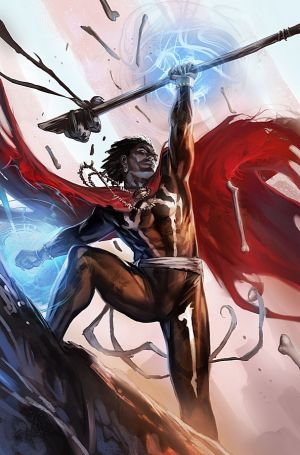 |
It is doubtful that a character like Doctor Strange could have as great a cultural significance as Doctor Voodoo can. Doctor Strange, with all of his fantasy elements cannot achieve the type of significance that Doctor Voodoo can with his real world religious and cultural elements. A character like Doctor Voodoo can seriously contribute to the promotion of greater tolerance and understanding. This might be a tall order for a fictional hero to fill, but isn’t that what heroes and superheroes are supposed to do? They overcome evil, intolerance, and bigotry. Doctor Voodoo, as a True Sorcerer Supreme, just might be up to the task.
© Copyright 2002-2026 by Toon Doctor Inc. - All rights Reserved. All other texts, images, characters and trademarks are copyright their respective owners. Use of material in this document (including reproduction, modification, distribution, electronic transmission or republication) without prior written permission is strictly prohibited.