|
|


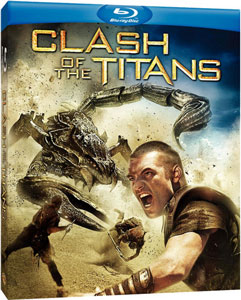 |
Clash of the Titans is based on Beverley Cross's screenplay for the 1981 movie of the same name. Both films draw on the classical Greek story of Perseus and Andromeda, but neither of them worries overly much about faithfulness to the source material. The original, the last film to feature the unique stop-motion creature vision of Ray Harryhausen, was performed like a stage production, complete with a legendary cast of stars of stage and screen.
This 2010 version is much different. It has creatures, to be sure, but it's filmed in extraordinary locations where the landscape is really extreme: Tenerife, Ethiopia, and an abandoned quarry in Wales. It's dirty, muddy, bloody, sweaty, and very, very sexy. It's proletarian, and it rocks.
At the time the movie begins, resistance to the Gods is on the rise, and the city-state of Argos has taken the lead in the struggle to cast off the yoke of Olympus. The people protest the God's oppression and cruelty. They protest the abuse and neglect of the Gods, and have no heart for the love and prayers the Gods demand. Argos has decided to overthrow the Gods through armed resistance. The army has toppled the statues and set fire to the shrines. Zeus is fuming at their disobedience. Hades is hell-bent on punishment. "A new era is upon us, the era of man," cries the King of Argos, in a moment of hubris that he would live to regret.
Perseus (Sam Worthington), a young fisherman, is unwillingly thrust into this conflict when Hades kills his beloved family. Perseus seems to care little for the battles between Kings and Gods, but he wants revenge. So he takes up a sword and, with a small escort of soldiers, he sets out from Argos to complete the epic challenges that will ultimately bring him face-to-face with the dreaded God of the underworld.
What follows is part fantasy quest, part buddy film, part romance, and part political drama. Perseus becomes a man pitted in a mighty struggle against his own divine nature. He battles the Gods alongside a sharply pragmatic warrior named Draco (Mads Mikkelsen), the ageless and beautiful Io (Gemma Arterton), a handful of faithful soldier companions, and two exuberant brothers, hunters by trade. Along the way, they are joined by a jinni, a magical desert creature who knows better than any human what the brotherhood of man can accomplish.
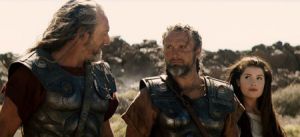 A phenomenal supporting cast of humans gave this movie heart and soul. |
Who are the Gods of Greece? They are abstractions, like beauty, honor, and truth, or speed, strength, and skill in the hunt. But they are people, too, even if they are not human. They are capricious and emotional, unable or unwilling to control their baser emotions like pride, prejudice, and jealousy. The stories of the Gods are cautionary tales that the ancients told themselves, warning against the excesses of unrestrained power, and the failures of self-restraint.
Among the greatest legacies of ancient Greece is humanism. "Man is the measure of all things," said Protagoras (ca. 485-410 BC). In this simple way we see summarized some of the most abiding concerns of the ancient Greeks, who argued that reason could accomplish more than belief, that the natural world (not the supernatural) will satisfy our needs and define our limits, that the individual intellect was the key to shaping a community's destiny, and that the quality of human life fundamentally mattered, no further justification necessary. Prior to this, civilizations, including that of the Greeks, held that the Gods were the measure of all things. But the humanistic creed held that the center of experience, knowledge, and virtue was found in the human being, not on Olympus.
Still, the loss of the Gods could come with a terrible price. By forgetting the lessons threaded into the cautionary tales of Gods and men, humans threaten to embody all the excess, cruelty, violence and caprice of the Gods. We could become the very thing that we so hate and resent. This is why hubris – an excess of pride, ambition, even arrogance – was the cardinal sin of Greek culture, the one sin to avoid committing at all costs. We are only safe from our worst natures when we remain humble.
The number one reason that Clash of the Titans is so engaging and so interesting is that, regardless of whether it tells the "true" story of Perseus and Andromeda, it tells the story of the birth of humanism in all its splendor and danger. The leap from Olympus to Earth isn't an idle one, the stuff of armchair speculation. It's made in the trenches where powerful interests kill to stay alive.
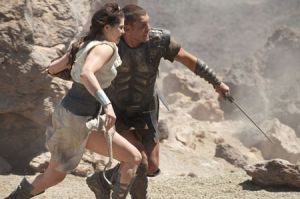 Fantastically beautiful bodies played well against the gorgeous scenery. |
The central drama of Clash of the Titans is the ancient Greeks' attempt to invent humanism. It is humanity trying to free itself from the control of the Gods in the face of fierce resistance, not only from the powerful who benefit from our submissiveness, but from the religious fanatics who preach fear, submission, obedience, and conformity, fanatics who resort to anarchy when they are most deeply threatened. It's a rousing tale that never loses its relevance.
The film eschews Ray Harryhausen's distinctive stop-motion animation, that amazing technique that fascinated us through the years in classics such as Mighty Joe Young, The Seventh Voyage of Sinbad, Jason and the Argonauts, and 1981's Clash of the Titans. This point is made rather dramatically by the brief appearance of Buko, the enchanting golden mechanical owl from the 1981 movie. "Take everything but that," snarls one old graybeard, as the soldiers gather their weapons for their quest.
But the movie does not eschew Harryhausen's larger vision: a vision of inserting creature effects into live action. I remember being utterly bedazzled as a child as Jason defeated the giant bronze statue of Talos. It was utterly unforgettable, not least because it happened on a real rocky beach and Jason was a real man. I had the same sensation of bedazzlement in Clash of the Titans, watching the giant scorpions navigate the steep rocky slopes of the Ethiopian mountains, and the breathtakingly beautiful Pegasus greet Perseus in a green and verdant wood. Just as Ray Harryhausen did for the last generation, director Louis Letterier does for this generation: he brings the Gods to Earth.
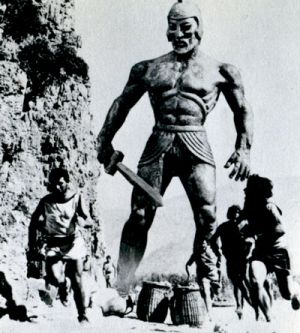 The Argonauts flee as the great bronze Talos comes to life. |
The real problem with this movie – and it is definitely a big problem – lies with the characters of Zeus and Hades. Played by Liam Neeson and Ralph Fiennes, these two had the worst lines, the worst costumes, and the worst special effects imaginable. Overblown, overacted, and utterly ridiculous, the scenes featuring these two (usually) truly fine actors were teeth-clenchingly awful.
To enjoy this movie, you have to overlook this pretty glaring flaw. I was able to because I wanted to, because I enjoyed the heroic quest of the warriors so much. The movie's central drama, seamlessly interacting with awesome scenery and awesome creatures, great fight choreography and an excellent soundtrack, was so entertaining that it was worth alternately cringing and laughing disparagingly during the scenes on Olympus.
The movie had an unsatisfying ending, if you consider how much was sacrificed, for so little gain. However, it did leave an opening for Clash of the Titans 2, currently scheduled for release in 2012. I can't imagine what story it will tell, and I don't hold out a lot of hope that the second film will capture the upstart mojo of the first. I don't plan to play the video game either, because I'm into motion gaming these days. But if you want to sit back and watch an engaging story while munching your popcorn on Friday evening, this is a good option. It's good to remember what it once took to become human.
© Copyright 2002-2026 by Toon Doctor Inc. - All rights Reserved. All other texts, images, characters and trademarks are copyright their respective owners. Use of material in this document (including reproduction, modification, distribution, electronic transmission or republication) without prior written permission is strictly prohibited.