
Trauma Center: Under the Knife
By Josh Hechinger
November 17, 2006 - 18:37
Studios: Atlus
Atlus
Rating: T
Genre: Medical Simulation
Platform: Nintendo DS
 |
| I'm not a doctor, but I play one on my DS. |
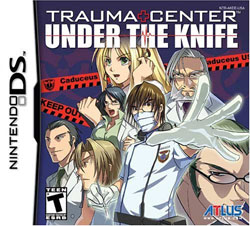
The game follows Dr. Derek Stiles, a talented, yet inexperienced and absent-minded, surgeon in the year 2018. The early part of the game focuses on Derek learning how to take his profession seriously under the guidance of his superiors and support staff.
Derek eventually develops a rare ability known as The Healing Touch, an ability that makes itself known as bursts of extreme focus and precision during surgery. He soon has ample opportunity to hone this miraculous ability against the outbreak of an incredibly lethal and resourceful virus called Gangliated Utrophin Immuno Latency Toxin, or GUILT.
But GUILT is no ordinary virus; it’s the work of a medical terrorist group known as Delphi. Derek joins Delphi’s opposite number, Caduceus, and is soon on the frontlines of combating this virus.
Trauma Center: Under the Knife is a medical simulation, where surgery is performed using the Nintendo DS’ touch pad and stylus. This is a game designed to make full use of the unique interactive aspects of the system. The directional pad and buttons are superfluous, as the entire game can be played with taps of the stylus.
Naturally, the real meat of the game is in the surgery simulations. Each surgery is timed, has certain objectives, and is subject to complications arising that the player must adapt to. The surgeries are complex, generally ranging anywhere from “Hm, Tricky” to “Argh, Stupid !@#$ Game!”. This isn’t just a quirky little showboat for the DS’ stylus, it’s a genuinely challenging game experience.
In the earliest surgeries, the player is introduced to their various instruments (scalpel, suction, needle and thread, and other items) and certain basic medical techniques (such as how to suture wounds or drain and extract tumors). While the in-game assistant guides the player through the jist of each surgery, it is left up to the player to remember how every instrument and technique works. This adds a welcome bit of realism and shows the developer’s confidence in the average player’s intelligence.
The first half or so of the game is a straight-up medical simulation: the player deals with lacerations, tumors, lesions, and other “realistic” injuries and ailments. After GUILT is introduced into the plot, the diseases become more fantastic, with poison-gas-releasing crystals and wiggly things that open up cuts in a patient’s stomach.
The gameplay also takes on something of a puzzle aspect when GUILT hits the scene. One strain of the virus requires removing chunks of it in a certain order, so that it doesn’t regenerate. Another requires a specific sequence of color coded injections. If nothing else, the GUILT virus adds that much more spice and variety to an already complex game.
The graphics of the game are crisp and smooth. The depiction of the various organs and body parts the player roots around in for medical purposes is tastefully done; not squeamishly realistic, and not distractingly fake. The cast is rendered in Japanese style, although not a particularly exaggerated one.
The music is repetitive, but it fits the game well. It has a decided “medical drama” vibe to it. In a nice touch, each of the medical assistants have separate voices, albeit limited phrases. The sound effects are nothing impressive, for better or worse.
Outside of the surgery “missions”, the gameplay is linear and story based; the players doesn’t walk around the hospital or game world so much as read through chunks of plot and medical briefings before being deposited directly into the operating room. Happily, the text can be fast forwarded with a simple press of the Select button, which comes in very handy when you need to take another shot at a given surgery.
In terms of character and plot, the game doesn’t quite measure up to the engaging and innovative gameplay. Derek and his chief assistant, Angie Thompson are fairly generic characters. You’ve met Derek before; he was the Talented But Inexperienced Main Character of pretty much every medical drama ever. Oh sure, he might have had a different haircut when you saw him, or wasn’t rendered in anime style, but it’s still the same guy. And Angie is Figure B.1 out of the Supporting Character Textbook; that’s the figure entitled Tough-On-The-Outside-Sensitive-On-The-Inside-Sidekick, by the way.
The plot has potential, but the delivery is a bit bland. A medical mystery loses some of its bite when the player is being led by the hand through it. But the delivery isn’t entirely lacking, and I can’t help but be impressed with some of the game’s storytelling choices. Terrorism tends to be a touchy subject in this country, even if it’s with viruses instead of bombs and takes place in the not-too-distant future.
Subjects such as euthanasia and the plight of third-world countries are also covered, the former becoming a major subplot for a time. Delphi's motive, that doctors are playing God by saving lives, is surprisingly deep for what could have easily been just a piece of entertaining-to-play fluff.
The supporting cast of the game belies the blandness of the main characters. There’s an aged doctor who has all but given up medicine due to the pressure of having the Healing Touch; a female cop turned tough-as-nails doctor; a secret practitioner of euthanasia.
Trauma Center initially saw a very limited release, and was soon out of print (much like the sleeper hit Phoenix Wright: Ace Attorney, which is also mentioned in the same breath as this game when the DS' library is extolled). However, increased demand based on worth of mouth has brought the game out of the mothballs for a second run. While it’s hard to find on shelves as of right now, most game stores should have no problem ordering you a copy. The game has had something of a surge of popularity recently, and a sequel will be available on the Nintendo Wii.
The gameplay is challenging and well-thought out. The story doesn't hurt the game, but I can't shake a feeling of missed potential. Since this is a game and not a medical drama, more focus is given to "Oh, here's a new GUILT strain to fight" than complex issues of medical ethics. Which is perfectly understandable, but I wouldn't mind a TV show adaption all the same.
In any case, every video game system has a few games that can truly be considered gems. To this end, Trauma Center: Under the Knife is a diamond: it’s rare, it’s very hard, and it’s well worth owning.