
Invaders from the North
By Avi Weinryb
January 12, 2007 - 10:28
I have returned from my travels and as promised, here is a complete review of the recently published
Invaders from the North: How
Click here for the publisher’s description of the book.
The review begins below:
# # #
If you get past the freaky cover art, you will discover that Invaders from the North is an astounding addition to the slow-growing pile of books that focus on comic book criticism and history. An added boon is the fact that this micro-tome pins its focus on Canadian contributions to the comics world.
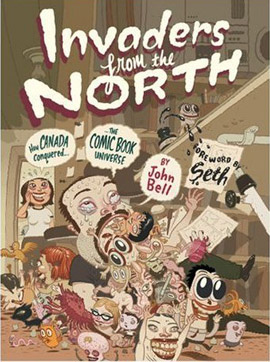
Just like in the US, Canadian comic strips of the late nineteenth century gave way to serialized collections which would eventually spawn the exciting graphic novels of today. Along the way, the Canadian superhero genre would see its muscles flexed, a slew of Canadian creators would head south, all as Canuck comics rack up critical acclaim the world over.
Archivist John Bell expertly weaves facts and observations with Canadian tax money (fat government grants helped make this book a reality) in order to illustrate the broad history and depth of the Canadian comic scene.
A ho-hum foreword by remarkable illustrator and graphic novelist Seth (aka Gregory Gallant) gets the ball rolling. A delightful romp through the early years of Canadian illustration sets a tone of inquisitive sincerity, and past achievements are carefully explored, leading up to the first of two ‘Spotlight’ sections.

Art by Seth - Excerpted from 'It's a Good Life if you Don't Weaken'.
The first ‘Spotlight’ is an examination of ‘Johnny Canuck and the Search for Canadian Superheroes’. It follows a careful exploration of the genesis of the Canadian comic book and the chronicling of the Canadian Golden Age of Comics, a fleeting period that lasted from 1941 to 1946.
After detailing the infamous comic crackdown that racked North America during the late 40s to early 60s, Bell leads us into the underground comix scene.
What is so exciting and refreshing about this book is that it shows everything from a Canadian perspective. I have studied the comic crackdown and the underground scene before, but the majority of my research materials tended to be written from an American perspective. Invaders from the North provides a look at the bigger picture by showing readers what was going on just north of the border. Some of these events impacted (and continue to impact) the overall North American comic scene, and they are definitely worth reading about.
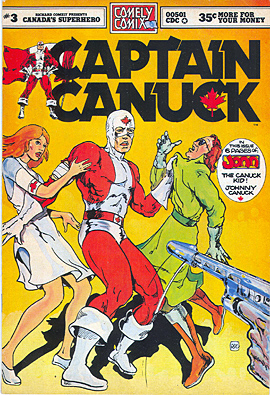
One of the many reincarnations of Captain Canuck.
I only carry one gripe about this book, something which should not prevent you from making it the newest addition to your comics shelf: This book is very fragmented. It feels as if (excellent) research notes were cobbled together in a hurried fashion in order to meet the deadline of pre-Christmas publication. It is as if each individual chapter was originally meant to be published independently of the rest. Concepts and names are sometimes re-introduced or repeated unnecessarily. A glaring example of editor Michael Caroll’s rush to publication can be found on page 51, in which the second half of the last uninterrupted paragraph is reproduced almost verbatim in the second half of the last uninterrupted paragraph of page 68. The ‘Spotlight’ section cannibalizes the previous chapter.
Editorial mishaps aside, this book carries a powerful message of the unique contributions of Canadian comic creators. It also demonstrates that the Canucks are in many ways no different from their American neighbours, and the parallels between our comic histories testify to this fact. Comic enthusiasts in either country continue to shout “Comics are a legitimate form of creative literary expression!” while waving about our dog-eared copies of Maus and Yummy Fur.
This is a book worth owning. It makes a valuable contribution to the field of comic book history, and it contains great facts and fun visuals.
8.5 / 10