
Free Culture – A Web Lecture
By Hervé St-Louis
November 18, 2008 - 00:45
This lecture is based on a presentation given at Social Contexts of Communication and Information Technologies COMS623, a graduate class in the Department of Communications at The University of Calgary, on November 18, 2008. This lecture covers the book Free Culture by Lawrence Lessig. Dr. Patrick Feng is the seminar's instructor.
What?
Free Culture, published in 2004, is about free culture a term coined by Lessig. In this book, he explains his theory of how the Internet and related technologies has changed the private usage of copyrighted material. Lessig likens free culture to free speech, free election, free trade, free enterprise. Free does not mean that users are free to pirate copyrighted contents. Free means that culture is about the exchange of creative works allowing subsequent generations to build over them. Copyrights are necessary but to allow current creators to earn a living from their work, not control culture.
Who?
Lessig is law professor at Stanford University, Lessig is one of the main activist and thinker of copyright law and how it needs to be reformed in the United States. Lessig has recently changed his focus on copyrights to focus on corruption in the American Congress.
How?
Lessig eschews the scholar route to speak with the public through a series of case studies he uses to explain his premise on free culture. On his Website Lessig.org, the author encourages citizens to participate on a Wiki allowing them document cases of corruption in politicians. Much of Lessig’s public efforts and discourse is done to engage the public and encourage them to participate in the democratic process. Lessig also facilitate the public’s access to his writings by keeping free digital versions of his books on his Website and putting them under the free commons framework.
Why?
Lessig’s Wiki, I argue is much like an experiment of deliberative democracy. Deliberative democracy is field of political thought about finding ways to involve the public – non-experts – in political debates about topics such as technology, the environment, health and other topics. Though many models exists, through continued exchanges with experts citizens become immersed in specialized knowledge and are better equipped to make decisions about topics in a traditional pluralist setting.
Where?
Lessig’s view of free culture are steeped in a determinist tradition. His model of seeing culture as something succeeding generations contribute to and that the intent of lobby groups to pull away their contribution from the mix, disrupts the normal course of cultural innovation. His way of seeing the Internet as a new frontier that broke away the business model of copyrights holders, and that copyrights must adapt to a new reality is again steeped in determinism. His approach to the Internet, is more one where he sees it as a black box, in this case that affects both copyrights holders and the public.
When?
To understand when copyright law, in the United States, according to Lessig, charts the continuous extension of copyrights renewal and how automatic copyrights given upon the creation of a creative works is against the wishes of the drafters of the American Constitution. Since 1962, the American Congress has extended copyright protections, continuously, Lessig argues, at the behest of lobby groups. In 1790, copyrights in the United States lasted no more than 14 years. Today, as of this writing, works are accorded protection for 95 years, whether they are registered or not.
Piracy and Property
Lessig divides Free Culture in two parts, Piracy and Property. Piracy is as defined by Hollywood interests is what users are doing currently when exchanging files and reassembling them in new creations. Thus, every time someone uses a creation, if no permissions are asked, the owner has loss some value to his property. Hence, any usage of property that is not authorized is piracy. For example, when the Girl Scouts of America sign a song over a campfire, they pirate the property of the song’s composer if they do not pay for usage rights. The composer has loss value. Before the age of Internet, such matters were outside of copyrights laws, because there was no easy ways of distribution of digital contents.
Norms, Laws, Market, and Architecture
Lessig introduces a simple model to explain how various regulations affect users. Norms, architecture, laws and market forces all regulate people. Lessig argues that copyrights protection lobbies are trying to use laws to legislate other types of regulations, such as architecture and market forces. For example, by inserting copy infringing technologies in devices and technologies and banning users from tempering with them legally, lobbies start controlling how users make private usage of copyright contents. When laws are enacted to stop the selling of second end technology and license transfer, lobby groups, again use laws to enforce their control. All of these, of course affect what was once clearly outside of the world of copyrights and left to the private domain. This, Lessig argues, affects the traditional usage of free culture.
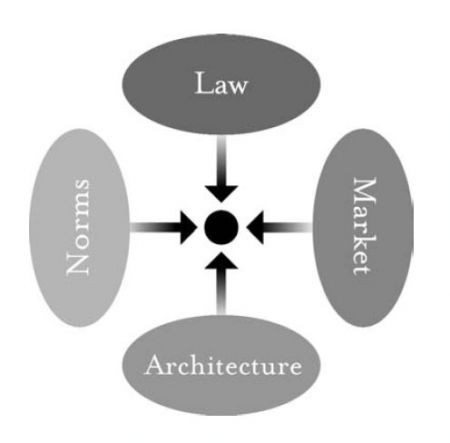 |
| Source: Lessig, Lawrence (2005), Free Culture: How Big Media Uses Technology and the Law to Lock Down Culture and Control Creativity, pp.121. |
Free Culture in Action
Without free culture, Lessig argues, new generations of creators and innovators cannot build upon the work of previous generations who seek to stop their past contributions to revert to the public domain.
For example Walt Disney’s Steamboat Willie, which is one of the main example of a works that should have reverted to the public domain, years ago, borrowed heavily from Steamboat Bill, a movie by featuring Buster Keaton and used as an inspiration mere months after it was released by its producers.
A case study of the limits of copyrights and the fights occurring because of the Internet, are fan films. Fan films are independent productions, often created by film school students, graduates, or amateurs about existing fictional characters and creations. One of the most famous fan films is Grayson.
When it was first aired online at the 2004 San Diego Comic-con, publisher DC Comics threatened to boycott North America’s largest comic book convention if the short film was featured, as it was intended. When copyright laws were drafted two centuries ago, they never gave copyright holders the right to stop other people from making what is known as derivative works. Adaptations were not covered.
Yet, if copyrights are allowed to rule over culture, they could stop it from developing. For example, this parody about the Apple’s Mac versus PC commercials, featuring Linux, only exist because parodies are still protected from copyright laws in the United States.
However, how media groups attempt to appropriate to themselves more control over culture is worrisome. This interview I shot at the 2007 San Diego Comic-con with my own camera, edited with my own computer, and obtain proper authorizations from the interviewee, press hearing’s publicist, hence the studio was removed from You Tube last year, after alleged copyrights violations! Apparently, Viacom, the owner of Black Entertainment Network said this video belonged to them. It was reinstated much later to my surprise. I have since had a chat with representatives from Viacom and they blamed it on their legal fight with Google/You Tube. Although, the video was reinstated, I, an innocent contributor to culture, was caught in a cross fire over material that I clearly owned.
Related Articles:
A Primer on Copyrights and Action Figures
Ramen Toy’s Maverick Action Figure Possibly Infringes Copyrights
Comic Problems #1: Copyrights versus Trademarks
Copyrights and the Superman Reboot
Copyrights and Comic Book Creators: Be Careful What You Wish For
Superman, Moses, Copyrights and the Public Commons
Response To Tom Spurgeon: Copyrights, Superman, and the Estates of Siegel and Shuster
Superman – More Copyrights Stupidity
Copyrights 101 - Why You Must Care About This
Conservative Party of Canada Musing New Copyright Policy