
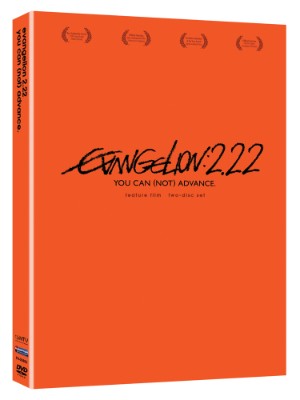
Evangelion 2.22 You Can [Not] Advance
By Chris Zimmerman
April 1, 2011 - 10:30
$29.98 US
Starring: Spike Spencer, Tiffany Grant, Colleen Clinckenbeard
Directed by: Hideaki Anno
Produced by: Studio Gainax
Running Time: 112 minutes
Release Date: March 29, 2011
Distributors: Funimation Entertainment
 |
Evangelion is no stranger to the big screen. Director Hideaki Anno was originally dissatisfied with the ending of the series and thus conceived a pair of theatrical features to properly bring his animated opus to an end. But rather than cap off the many lingering plot threads left dangling, the films instead devolved into trippy psychedelic sequences that made audiences question if there ever was a meaning to the series to begin with. Flash forward to today, and Evangelian is once again infiltrating the big screen as a series of films meant to retell the series in a somewhat straightforward manner.
Dubbed 2.22, the movie condenses episodes 8-19 into a two hour time frame while changing up a few key aspects to keep old fans invested. The characters themselves remain familiar enough, with some a few twists added to their personalities to add variation to what we are already familiar with. One such example is the introduction Asuka, whose character portrayal in the original was more of a brat starting out, who secretly pined over Kaji, whereas here, she retains her braggart personality but is quicker to recognize her shortcomings. Her infatuation with Kaji is also dropped.
The plot of the film mainly focuses on the introduction of Asuka, as she must adjust to life in Japan and working as part of a team with the stoic Rei and whiny Shinji. The film explores the clash in their personalities, as well as Asuka’s eventual acceptance of her new comrades. Of course, there are major battles throughout, as well as the usual patches of religious imagery fans have come to expect from the franchise.
 |
There are two noticeable differences that separate the films from the series, the first of which being the addition of new EVA pilot Mari. The character was absent in the original episodes and created specifically for the film. The character makes for a sharp counter point to the already established pilots, all of whom are either downtrodden or serious in their approach to battle. Mari however is none of those things, being lively and jovial in regards to her position. This is a bold departure from the personalities of the original pilots, who all demonstrated social anxiety or were ill-suited emotionally to handle the duties of piloting the EVAs.
The other noticeable difference between the film and the television series is the upgrade in animation. With the advent of new technology, it’s only a given that Gainax would want to test the waters with their biggest franchise. The film’s make abundant use of the CG animation is definitely an upgrade over the stiff movements originally employed as a result of a low budget. The animation is vibrant and the character renderings smooth and polished. This is the best Evangelian has ever looked and well worth the second dip for those unhappy with the shay frames and muted colors of the original.
 |
Continuing the trend of bringing back the original voice actors, Funimation secured Tiffany Grant to reprise her role as Asuka. This is a welcome relief, as the series original dub cast was stellar in their roles and any major changes would have proved distracting. That said, the roles that were recast do blend nicely though it takes a while to fully adjust to them.
On the extras side of things, we get a nice 22 minute feature that takes audiences through the re-imagining process, from the early production to the conceptualization of the art design. Especially appreciated is a commentary track gathering together the principal cast and director from the dub, taking turns in small segments to comment on the film. Sadly though, the commentary doesn’t last the entire films runtime and cuts out around an hour and a half into the feature.
Neon Genesis Evangelion 2.22 is an exploration of what made the series a success, while adding its own signature flavor to the mix. It retains the same intensity and drama made famous by the original, while incorporating improved animation and new story beats that arguably put it a notch above its previous incarnations. It’s rare that a remake outshines the original but 2.22 proves it can be done, and it does so with gusto.
A+
Related Articles:
Neon Genesis Evangelion: Volume 14
2013 Japan Film Festival Premieres "Evangelion 3.0"
Neon Genesis Evangelion 3-in-1 Edition: Volume 2 manga review
Neon Genesis Evangelion 3-in-1: Volume 1 manga review
Neon Genesis Evangelion: Volume 13 manga review
VIZ Media Offers 2 Neon Genesis Evangelion in November
Game x Evangelion at 2012 J-Pop Summit Festival
2012 J-Pop Summit Has Evangelion Stamp Rally
2012 J-Pop Summit Has Evangelion Museum
Evangelion Vol. 13 to Have Simultaneous Release