Interviews
Cerebral Sand Storms - Part 1
By
Koncise
January 8, 2007 - 08:00
Easy Cats :)
A little while ago, I had the great opportunity to converse with one of my favourite authors.
Unfortunately it was a bit one sided and Mr Tolkien wouldn't agree to do an interview, but I managed to rope the prolific Kevin J Anderson into spending some time with us instead :)
This piece was meant to go up some weeks back (in 2006), so a BIG apology to Mr Anderson and thanks for holding tight.
This is part one of a double interview, so sit back relax and let's go for a journey through his mindset:
Visions of Dune!
(1) - Koncise: When did you first get introduced to Dune and what was it that took hold of your imagine??
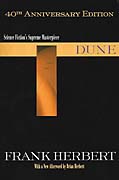
KJA: I had bought it when I was 11, I think -- a fat Ace paperback book with a giant (cartoonish) sandworm on the cover.
Even then, I had heard from enough people that DUNE was *the* classic that every SF fan had to read? But I put it off for several years because it was so big, so complicated-looking.
I think I actually read it when I was 13, and I fell in love with it.
I read it as an adventure story. Later, I read it again when I was a freshman in college, and suddenly I saw all the politics and
economics and ecology, and it was a much richer experience.
I have read it many more times since then, and each time I get more out of it. The world is so rich and detailed, you feel as if you're actually there?
(2) - K: Did you pick up the sequels straight away?
KJA: I read DUNE, then DUNE MESSIAH, then CHILDREN OF DUNE as a senior in high school. Then, my freshman year of college, GOD-EMPEROR came out, and of course I couldn't wait.
That was the first hardcover book I ever bought, and I still have the copy.
(3) - K: Did the sequels heighten the Dune experience, detract from it, how did they leave you?
KJA: I loved them all. Some people didn't like how MESSIAH turned Paul from hero into anti-hero, but I saw the beautiful, tragic arc.
Several scenes in MESSIAH are among the most powerful parts of the whole series. I also liked CHILDREN; at the time I wasn't reading them with the mind of a hardline critic, but someone who loved to explore the ideas and imagination. GOD-EMPEROR has an absolutely terrific beginning and ending, but I thought the heavy philosophy in the middle was a little slow.
Upon rereading (and greater life experience) though, I find it all very engaging.
I bought HERETICS and CHAPTERHOUSE as soon as they were released as well.
(4) - K: I had the same experience with the books myself.
I haven’t re-read (well, listen) to God Emperor yet though.
Was Sci-Fi what you were really into??
KJA: Always, since I was five years old.
I loved the big monster movies when I was a kid, and I drew monsters and aliens and spaceships in my school notebooks.
I started writing SF stories when I was only eight years old, and never stopped.?
(5) - K: So did you use to watch the dramatised Flash Gordon and the Forbidden Planet black & white shows?
KJA: Wow, I'm not that old!
I was still a kid in the late 60s/early 70s, so what I remember watching is Lost In Space, Star Trek, Battlestar Galactica (and as I type this, I am at DragonCon in Atlanta; my wife and I were picked up at the airport with Richard Hatch -- Apollo from the original Battlestar Galactica -- and Marta Kristen, Judy from the original Lost in Space).I went to see Star Wars in the theatre when I was a freshman in high school.
(6) - K: I meant did you watch the re-runs lol over here they used to show them in the mornings during school holidays :)
Did show’s like Battlestar Galactica, (with the man against machine struggle) or any of these other show’s have any real impact on your writing, do you think?
KJA: Sciene fiction as a whole did, all the show, all the movies, especially the 50s monster movies and alien invasions. Frank Herbert talked about the Butlerian Jihad and the war against the thinking machines back in 1964, so the background wasn’t affected at all by Battlestar Galactica or other things. (I got a kick when one reviewer claimed we had “stolen” the idea for the Butlerian Jihad books from the Terminator movies!
Frank Herbert set that up more than 20 years earlier!
(7) - K: Do you still have any of your old stories from when you were a kid?
Do they read well?
KJA: I still have some of the original ones, and outlines for about a hundred Star Trek fan stories I wanted to write. In the years since, I have mined them for some of the good ideas. They're badly written, naturally, but they do show that my imagination was working overtime.
(8) - K: Do you read or explore books??
KJA: Actually, I read them. I love stories, and I want the author to tell me what happens, who it happens to, where it happens. I am a very receptive audience, and I want to be amazed, and entertained, and taken to a strange and exotic place. I am not overly enamoured with the poetics of the language itself, the deep intricacies of metaphors and hidden meanings in a precious or clever turn of phrase. I am much more impressed with an author who can throw an unexpected new idea at me, or create a gripping scene that I can visualize in my mind.?
(9) - K: Have people ever asked you about things they've perceived you've written into your stories?
KJA: The marvellous thing about books is that every reader sees something slightly different, running each novel through his or her own set of filters. Some fans have written me about amazing parallels they perceived in their own lives, or how some plot twist or character had particular meaning to them.
Many times, I didn't even consider a certain aspect when I was writing it, but that doesn't mean a reader can't pick it up. Especially in the young adult books I write (mostly with my wife Rebecca Moesta), the readers are very much affected -- and they write letters to tell us so.
(10) - K: What effect do you think Dune had on you pre- writer and post-writer??
KJA: Early on, I was already hooked on science fiction, but DUNE really kicked it up a notch² for me, showing me that a great SF novel could be much more than an adventure in an exotic place. The world building, the politics, the intricate plotting was absolutely the best I had ever seen.
As a fledgling writer, I studied not only DUNE, but all of the Dune books and then all of Frank Herbert¹s other great books, such as HELLSTROM¹S HIVE and THE WHITE PLAGUE.I learned very much from Frank¹s plotting and layering. I think I¹m a better writer for it.
(11) - K: I know this is strictly hypothetical, but do you think that you would have had a different writing style if it hadn't been for the Dune influence?
KJA: My whole outlook would have been different.My interests in Byzantine plotting, epic scope, attention to detail and "making sense," the politics, economics...everything was at least partly due to Dune and my reactions to those books. I could never have written my STAR WARS books without having the background in DUNE.I certainly could never have painted anything remotely as complex as my "Saga of Seven Suns" without the inspiration of Dune.
(12) - K: So, (for those that don't know) how did you get involved with writing in the Dune Universe?
KJA: We've described this in detail many times, in the afterword to HOUSE ATREIDES, in the introductory note to HUNTERS OF DUNE.I was always a DUNE fan, and was dismayed to find the story hanging uncompleted after the end of CHAPTERHOUSE: DUNE and Frank Herbert's passing. Brian was himself an accomplished SF writer, and I had built up some fairly decent credentials, many novels published, great reviews, awards, even bestsellers. When I approached Brian about finishing the obviously incomplete story, we talked on the phone and immediately hit it off personally. It felt as if we were old friends from the very first conversation, and the energy has only built from there.
(13) - K: Do you think it was important to click with Brian on a personal level as well as a professional one?
KJA: Without a doubt.We have written well over a million words together now, nine novels -- all of them thick and complex.In a decade of working fairly intensely together, and going through the pressure-cooker of seven book-signing tours (which Jerry Pournelle calls the "writer's death march"), we've had one argument that lasted about seven minutes.We really respect each other's writing and we love to interact and brainstorm each new project.It keeps the enthusiasm building and building.
(14) - K: Nine?You wrote the two trilogies and the two new books to finally end Frank’s work.What was the other book?
KJA: THE ROAD TO DUNE, which came out last year, was sort of a “Silmarillion” for the Dune universe, with short stories, a short novel, and a lot of the never-published chapters, outlines, and notes from Frank Herbert.
(15) - K: So the first things you wrote together was the 'House Trilogy'.
Firstly, what made you start here?
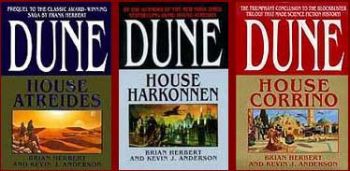
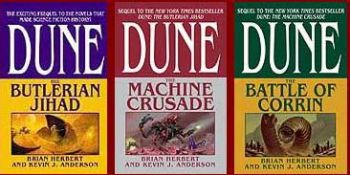
KJA: By the time we started considering our Dune projects, it had been more than a decade since CHAPTERHOUSE: DUNE was published.Though it was our original idea to wrap up the chronicles, we felt that jumping in immediately and doing "Dune 7" would be a mistake.We needed to reawaken interest in Dune, even introduce a whole new readership. One of the ideas we considered was to do the great Butlerian Jihad story, which Brian and his father had already talked about doing, before Frank Herbert's death.However, that would have been telling a Dune story without any of the familiar characters, settings, politics.So, we chose to do the immediate prequel to Dune, the love story of Duke Leto and Lady Jessica, their battles with Baron Harkonnen, the planetologist Kynes being sent to Dune to study the sandworms.Those books -- HOUSE ATREIDES, HOUSE HARKONNEN, and HOUSE CORRINO -- were extraordinarily popular in their own right, but they also sparked a threefold increase in the sales of Frank Herbert's original work.
Then, with that momentum, we continued with the Butlerian Jihad story to set up much of the story Frank had left in his outline for Dune 7, and now finally with HUNTERS and SANDWORMS we are writing the chronological grand finale.
(16) - K: I really enjoyed the ‘House’ books, but how daunting was it for you to, well, ripple the waters of such a beloved Universe, as it were?
KJA: It was a huge challenge and a great responsibility.We knew people would have incredibly high expectations, and we knew that for some readers we would never be good enough no matter what we did. But we have also reawakened a huge amount of interest in the Dune universe, in the original
Frank Herbert novels, and brought a lot of new readers to this great series.
We’re very proud of what we’ve done, and the vast majority of fans love it.
Each new Dune novel has sold better than the previous one, with HUNTERS OF DUNE by far the biggest bestseller of all.
(17) - K: How did you manage to replicate Frank’s voice, and still add your own flavour to the stories?
KJA: We did not try to copy Frank’s style or tone at all.We felt that would be difficult or impossible to achieve, so Brian and I wrote the books in the way that we normally write prose.Because we spent so much time and energy studying the original Dune novels, maybe a bit of his influence worked its way into our writing.
(18) - K: Was there ever a fear of the constraint that was wrapped around the characters?
What I mean is, we know where they are in Dune, so if you wanted to put someone in a perilous situation, we’d know they’d survived it.
KJA: Not at all.That all goes back to the skill of the writers.Justbecause you know one of the main characters won’t be killed in a perilous situation (because he or she is still alive in later books).That doesn’t mean there aren’t terrible consequences.In the House Books, we certainly put Duke Leto through a lot of difficult situations.Frank Herbert left a very large tapestry with a lot of room for us to tell stories.
(19) - K: One of the things that jumped out to me was the way we were introduced to Baron Harkonnen.
In Dune, Duke Leto show’s his character at the very beginning by the way he puts his life on the line for the workers of the spice carrier and it highlights the way he sees life and wealth.
However, in House Atreides we get a similar situation at the beginning of the book with the Baron in Duke Leto’s place, but with completely different sensibilities.
Was this done by choice, or was it just an organic element of the story?
KJA: Hmm, I never thought of the comparison so clearly.It must have been organic!
(20) - K: Likewise, there are two things that also jumped out in House Corrino.
There was a mention that Irilan had aspirations to be a writer.
And Jessica says to herself that Irilan was the type of woman Leto should marry.
Were these conscious additions to the story?
KJA: Well, Irulan is obviously a writer throughout DUNE, so that was perfectly natural.She has written most of the legends and propaganda turning Paul into such a great figure, and we’ll be telling a lot more of that story in the Paul of Dune trilogy.As for Irulan being a good match for Leto it seemed to be a natural thought given all the politics and connections.
(21) - K: The Dune books a filled with a wealth of science and politics.
Firstly, how much of the science is based on fact and do you do a lot of research?
Secondly, how do you go about creating the political landscape?
KJA: I have a science background, and some of that works its way into our Dune novels.However, these stories aren’t built on a rigorous background in science and physics (all the space travel, battles, etc.).We tried to be true to the original Dune novels and the level of technology we read there.For the political landscape, that is inherent either in what Frank Herbert established or comes naturally in the give and take of plotting.
(22) - K: When writing with Brian, have you found that one of you is into one concept more than the other?
KJA: In general, I’m more into the world-building and the big action sequences, while Brian leans toward the politics, religion, and philosophy. But we both expand and develop each other’s sections, so by the time we’re finished we have both gone over everything many times.
(23) - K: You mentioned that Frank (Herbert) and Brian had already started to talk about the Butlerian Jihad.
When writing the Trilogy, how much of these original views & insights did you follow?
KJA: We used some background and notes on the time period that Frank left, but Brian hasn’t told me any of the plot details he and his father developed together.
(24) - K: As so much of the known Dune tapestry is missing, did you fear fans/readers would be detached from the series?
KJA: That’s why we started with the House books, the immediate prequel to DUNE. We captured the audience of everybody who had read and enjoyed even the first book (in fact, we found that a lot of people read HOUSE ATREIDES without having read Dune).By the time we turned to the second prequel trilogy, we had shown the readers the quality of what we could do in that universe. If they liked the House books, they followed us to the Butlerian Jihad trilogy.
(25) - K: How about the fact that the main protagonist is the soulless artificial intelligence that is Omnius, the evermind?
KJA: We both found that Erasmus was much more interesting than the self-aggrandizing pain-in-the-butt Omnius turned out to be.
(26) - K: You said that at first, you and Brian thought about concluding the original Dune series.
Were your plans for this a lot different from what we’ll find within ‘Hunters of Dune’ and ‘Sandworms of Dune’?
KJA: No, we actually had the whole huge story in mind from when we started HOUSE ATREIDES (and there are tie-ins and clues all the way through the six books). And we still have several more books to go, and the plans have always been there.
(27) - K: Are there any plains to do a book similar to ‘Road to Dune’ and include these notes?
KJA: Not at this time.ROAD was very difficult to do, a lot of bookkeeping, obtaining permissions, sifting through thousands of pages and old manuscripts…and it appealed to a lot smaller audience.
(28) - K: Fans of Frank’s books and yours & Brian’s are used to seeing the script torn up, as it were.Can we expect more of the same with the conclusion?
KJA: We don’t believe in tearing up the script -- because we write in collaboration, Brian and I both have to share the same vision of the book.
We try to do all of the real wild brainstorming at the beginning and let the story go wherever it needs to go (while staying within the established parameters).
(29) - K: Was there any thought of just putting out one book rather than ending it with two volumes?
KJA: We had initially intended to do one book, but when we started poring over the outline in detail, mapping out all the huge events and scenes, we knew it was going to be much too big to fit into a single volume.(about 1400 manuscript pages).
(30) - K: Now that ‘Hunters of Dune’ (and ‘Sandworms of Dune’ next year) is out, what do you hope fans will get from it?
KJA: We hope they’ll be satisfied with the grand climax that fans have been waiting for…but also still intrigued enough in the Dune universe that they’ll read the other books in the series and the further novels Brian and I write.
K: Remember to come back for Part 2, but before then you can find out more information on what Kevin & Brian have instore for Dune at his site http://www.dunenovels.com/
Or go take a look at Kevin's site http://www.wordfire.com/
koncisekoncise@comicbookbin.com">koncise> an out :)
Last Updated: November 29, 2025 - 16:51
 ComicBookBin