Comics /
Cult Favorite
Comic Books as Soap Boxes
By
Philip Schweier
February 1, 2012 - 12:15
First off, let me say that I have no particular political
leanings, left or right. I don’t believe conservatives nor liberals have all
the answers. I prefer to regard myself as a progressive, supporting those
political efforts that move the country forward.
A buddy of mine recently shared with an
article by Darin Wagner over at bleedingcool.com. A conservative, Wagner
lamented the growing liberal politics found in comic books these days. The
point of Wagner’s article is that the encroaching liberal bias must stop,
otherwise the comic book industry runs the risk of alienating half its
readership and thereby diminishing its audience even further. I can’t say his
point is valid or not; he seems to assume the comic book audience is largely
conservative. I agree it would be detrimental to drive away a portion of the
readership, but many comic book readers do want a certain amount of political
content; “real world elements,” if you will.
The article cited instances within the DC Universe in which comic
book characters are portrayed as having a more liberal viewpoint of the world.
For instance, in a Birds of Prey
story, Black Canary comments on the questionable safety of SUVs while driving
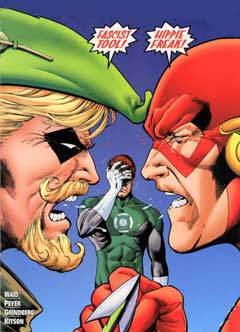
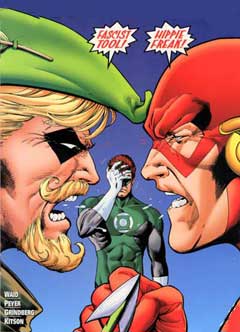
one in pursuit of a bad guy. Any character that has been affiliated with Green
Arrow (perhaps the best known liberal in the DC Universe) is likely to have a
Democratic viewpoint herself. Nevertheless, I think this is an unrealistic
thought on the part of the character. Were I in pursuit of a major criminal, I
would be thanking the Detroit automakers for manufacturing such a tank-like vehicle,
rather than grousing about its questionable safety rating.
Another example is a moment in a Brightest Day #7, in which conservative
Hank Hall destroys a jukebox playing a Dixie Chicks song. This is a reference
to a negative comment made in 2003 by Natalie Maines of the Dixie Chicks about
then-U.S. president George W. Bush. According to Wagner, Hank Hall is depicted
as the “team jackass” with no regard for personal property. I agree such
negative portrayals are out of place and only convey a liberal bias that may or
may not exist.
Wagner refers to super-heroes as being apolitical, but I disagree. Instead,
they exemplify moral righteousness by the way they enforce their own brand of
justice. But it’s difficult to determine which side of the political aisle they
may be on. Defying authority and operating (usually) outside the law could be
seen as a liberal trait, but doing so to enforce their world view of what is
right and what is wrong might be perceived as more conservative.
I won’t say that all of Wagner’s remarks hold water, and someone
else might argue that the conservative movement in comics has held the floor
too long and this is the liberals getting their due. Comic books in the 1950s
and ‘60s were written and drawn by men who were products of the Eisenhower
administration, so a conservative approach was rather common. In the 1970s, in
the aftermath of the counter culture movement, the trend was pretty much the
same with few exceptions.
But I do agree that often, writers will use their stories as a means of
expressing in some small way their own personal beliefs, which can alienate a
significant portion of their intended audience. Many comic book writers have
some particular ax to grind and constantly use their stories as a means to beat
readers over the head with it. The danger there is twofold: the message is
repeated so often it loses any meaning, and readers lose interest in the story.
Realistically, politics have crept into writing ever since the first caveman
scrawled on a wall with a dirty stick. However, artists and writers have an
obligation to their audience to depict political views accurately.
For instance, in 2003, John Ney Rieber and John Cassady presented a
Captain America story in which Middle Eastern terrorists took over the small
town of Centerville (pop. 600). The terrorist leader explains to the hostages
that their principle employer is a bomb manufacturing facility at the edge of
town. “This is how you feed our baby?” a wife asks her husband. “You make
bombs?” He defends his job by saying, “We make components.”
True enough. It’s not as if the employees of a U.S. Department of Defense
contractor are huddled over workbenches connecting sticks of dynamite to alarm
clocks and shipping them overseas.
This story has a personal viewpoint for me because my father was an electrical
engineer employed by the U.S. Air Force for several years, assessing and
evaluating various electronic systems and components. Never once did I
feel he was creating weapons designed to kill. In my eyes, he worked for the
Department of Defense, putting his knowledge to use in the defense of our
nation.
I’m sure I’m not the only family member of a soldier who feels this way. In the
case of the woman from the Captain America story, my concern is not her
politics, but in the nature of her written character. I believe a more
realistic portrayal would be her appreciation that her husband has a full-time
job with a government contractor, which translates into job security and good
benefits. Do the employees of gun manufacturers or cigarette makers question
the moral aspects of their jobs? I think not.
Granted, if armed men took my parents hostage due to my father’s job, I might
not be so complacent, but I wouldn’t blame my dad’s employer. I’d blame the men
with the guns for making war on non-combatants.
I won’t begrudge anyone their own politics, but I do believe there is a time
and a place for expressing one’s views. In my opinion, using a comic book
character as a mouthpiece is only appropriate when it is consistent with the
character in question. I challenge today’s comic book writers to portray their
characters’ politics accurately. It is the writer’s responsibility, especially
when said viewpoint is in opposition to the writer’s own.
Praise and adulation? Scorn and ridicule? E-mail me at
philip@comicbookbin.com
Last Updated: November 29, 2025 - 16:51
 ComicBookBin