Comics /
Cult Favorite
Helping Older Comic Book Pros
By
Philip Schweier
April 9, 2009 - 17:22
“ 'Let me help.’ A hundred years or so from now, I believe, a famous novelist will write a classic using that theme. He'll recommend those three words over ‘I love you.’ "
– Capt. Jim Kirk, “City on the Edge of Forever”
|
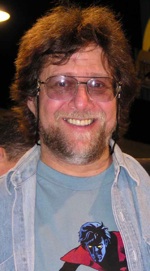
| Len Wein, creator of Swamp Thing and the new X-Men |
This week I read of the tragic situation of long-time comic book writer Len Wein. For those that haven’t heard, his home caught fire and his loss has been extremely painful. Thankfully, other than a family dog named Sheba, no lives were lost; nevertheless, it’s a painful loss and I’m sure many can sympathize with him.
Wein’s home office was destroyed, along with many rare and one-of-a-kind items from his long career. According to personal friend and science fiction writer Harlan Ellison, “everything Len had accumulated in a lifetime, from books to comics, to original art to his Shazam Awards (which were melted off the wall) to the complete set of DC library hardcovers that were caught in a heat so ferocious they melted into a 40-book block…spines bright and sharp and all one plastic-melted millstone.”
|
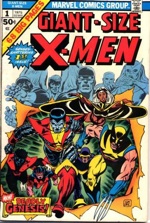
| Giant Size X-men #1, which Wein wrote, introduced an all-new X-Men team. The original artwork for cover by Gil Kane and Dave Cockrum, was lost in a recent fire. |
Ellison adds that among the items lost were “the original art for the first Wolverine story, the cover of
Giant X-Men #1 and other art pieces worth hundreds of thousands of dollars.”
As collectors, many of us have put years of hard work and money into our own collections. To suddenly and dramatically lose what we have worked so hard to achieve is a nightmare we can appreciate. It’s natural to want to lend a helping hand to someone who has contributed so much of his creativity to the hobby we all enjoy so much.
But Ellison goes on to say that while many well-meaning individuals are asking, “What can I do to help?” the unfortunate answer right now is...nothing. Wein needs time to mentally and emotionally process what has happened, and then see what kind of a settlement he can expect from his insurance company.
In time, there may be something for fans to do. Those of us in a position to help should, not only as a means of saying thank you, but because words and platitudes don’t mean much without actions to back them up. But the simple truth is, many of us are not in the best position to help Wein through this trying time.
For one, Wein lives in California, and most fans live too far away to be of much assistance. Perhaps if a fund is set up, we may be able to contribute financially to his family’s recovery. Regretfully, it is the simple fact that in the current economic climate, many of us are struggling, either faced with job loss or some other form of economic hardship.
So, what to do?
Well, charity begins at home, and if yours is not anywhere near Wein’s, then I respectfully suggest you look to your own community. Certainly there are charitable organizations such as the Red Cross, the Salvation Army and Goodwill who will appreciate a donation of money, time or service.
Many organizations have ties to the comic book community. Perhaps the one with the highest profile is The Hero Initiative (www.theheroinitiative.org), which helps support elderly comic book creators who, after years of working freelance, find themselves on extremely tight budgets and sometimes without adequate healthcare. The Hero Initiative helps the creators with grants, and sometimes with means of an income. There is also the Comic Book Legal Defense Fund (www.cbldf.org), which helps comic book creators defend their First Amendment rights, and retailers against unfair prosecution.
There is also the Christopher & Dana Reeve Foundation, (www.christopherreeve.org), which combats paralysis of all kinds. Fellow Superman actor George Reeves was the 1955 national chairman of the Myasthenia Gravis Foundation of America, and The Adventures Continue website (www.jimnolt.com) continues to raise money in Reeves’ name.
Meanwhile, there are other groups outside of comic book fandom who fight the never-ending battle for basic human needs. In the United States, there is Habitat for Humanity (www.habitat.org), which works to provide decent housing to the impoverished, and Feeding America (feedingamerica.org), formerly Second Harvest, which fights hunger.
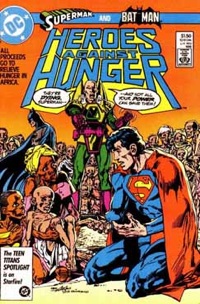
In the late 1980s, DC Comics published Heroes Against Hunger, which helped raise awareness of people who struggled on a daily basis to provide adequate food for themselves and their families. While that was more than two decades ago, the need certainly hasn’t gone away.
Often we might convince ourselves that we have nothing to offer in the face of such monumental problems, but that’s not true. One person’s contribution can inspire others, and often a one-on-one approach can make such a huge difference in the life of someone who is constantly struggling against misery, be it in the form of economic hardship, health issues or personal crises.
As fans of heroes of one stripe or another, it is only logical that we should strive to be heroes ourselves. It can be very easy to fight the good, the high-profile fight, expecting some recognition. It’s a lot harder to do it when you know you won’t get much other than thank you from a single individual – and maybe not even that.
In these uncertain times, it is critical that we be ready to lend a helping hand to our friends and neighbors who so desperately need it. I encourage everyone everywhere who has the ability to step up, on your street, in your town and say, “Let me help.”
Start now. Help your mom make dinner. Help a classmate get through his homework. Help a friend move.
Perhaps, as it was suggested in Harlan Ellison’s
Star Trek episode “City on the Edge of Forever,” those words will someday have a greater impact above all others.
Last Updated: November 29, 2025 - 16:51
 ComicBookBin