Comics /
Cult Favorite
The Many Faces of Captain Marvel
By
Philip Schweier
November 23, 2007 - 13:11
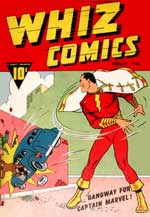
The original Captain Marvel was created by writer Bill Parker and artist Charles Clarence (C.C.) Beck, debuting in
Whiz Comics #2 in 1939.The first issue, featuring Captain Thunder, was an ashcan edition created largely to secure the copyright, and never distributed. He was modeled after actor Fred MacMurray, who is most widely known for his starring role on the 1960s sitcom
My Three Sons.
Later, Beck would give the good captain a more cartoonish appearance. Otto Binder would take over writing chores, and would come to be regarded as THE Captain Marvel writer. Beck became the character's defacto editor, overseeing a staff of artists to meet the needs of his publisher.
Part of the appeal of Captain Marvel was that he fed the active imaginations of young fans more effectively than Batman & Robin. While they could identify with the youthful sidekick, he took a backseat to the main character. With Captain Marvel, a magic word turned a boy into a hero. Like the Billy Batson persona, Captain Marvel has always conveyed a wonderful sense of youthful innocence that has endeared him to fans for decades.
|
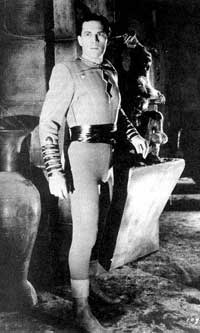
| Tom Tyler in The Adventures of Captain Marvel |
In 1941, the World's Mightiest Mortal was featured in an action-packed 12-chapter serial,
The Adventures of Captain Marvel. Republic was known for many low-budget productions, but was able to tap into many resources and talent to stage exciting drama and create surprisingly effective special effects for its time. Many afficionados regard it as one of the best chapter plays of the genre. Though Tom Tyler had the featured role, his dialogue is minimal, and spends most of his time leaping about and laughing at the bullets of the villain's henchmen. Frank Coughlin Jr., as Billy Batson, drives most of the story.
As Captain Marvel continued his comic book exploits, his popularity soared higher than Superman's. According to
Steranko's History of Comics Vol. 2, The World’s Mightiest Mortal would to consistently outsell the Man of Steel, with
Captain Marvel #51 hitting a record-breaking circulation of 1,384,000 in 1946.
|
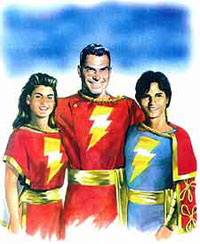
| The Marvel Family, as painted by Alex Ross. Kathy Ireland served as inspiration for Mary Marvel, with Fred MacMurray as Captain Marvel and Michael Gray as Captain Marvel Jr. |
New characters were added. Captain Marvel Jr., rather than fill a sidekick role, became a youthful version of his older counterpart. Mary Marvel, Billy Batson's long-lost sister followed in the family business. Uncle Dudley Marvel, the three lieutenant Marvels, a talking tiger and an evil genius worm all added to the Marvel family.
In the meantime, National Comics (as DC Comics was known at the time), claimed that Captain Marvel was blatant rip-off of its character, Superman. The case was argued back and forth over the next 14 years until, with sales dwindling across the board, Fawcett chose to get out of the comic book business altogether, and canceled Captain Marvel after 150 issues. National ended up buying the character, but neglected to do much with him.
|
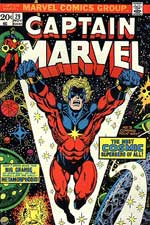
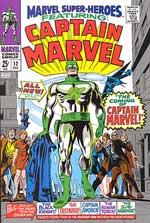
In 1966, with the name "Captain Marvel" now in the public domain, Marvel Comics publisher Stan Lee felt it only proper that his company should publish the title. After securing the rights, Marvel launched its own version of Captain Marvel, an interplanetary warrior named Captain Mar-vell who had been exiled from his own people who had attempted to invade Earth. Like the original Fawcett hero, he later became linked with a younger character, Rick Jones. Jones wore metal wrist bands which he would strike together, allowing him to trade places with Mar-vell, who was otherwise trapped in the Negative Zone, an otherworldly dimension.
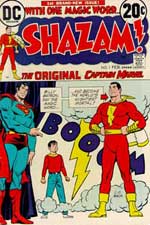
Meanwhile, DC retained the rights to the original, and revived the character in 1973. For legal reasons, the comic book was titled
Shazam! Longtime DC editor Julius Schwartz spearheaded the relaunch, but unlike his earlier success with characters such as the Flash and Green Lantern, he was instructed to retain all the original elements. Even C.C. Beck was hired to provide the art, but left the book after one too many disagreements. Kurt Schaffenberger, who had worked with him in the '40s, took over.
|
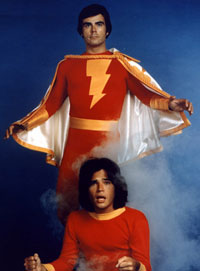
| TV's first Captain Marvel, as played by Jackson Bostwick. Michael Gray (below) portrayed his alter ego Billy Batson |
In 1974, Captain Marvel flew into living rooms everywhere in the form a live-action Saturday morning television series entitled
Shazam! Starring as the World's Mightiest Mortal was Jackson Bostwick, with Michael Gray as his young alter ego. The series deviated from the comic books in that Billy traveled in a motor home with Mentor, played by Les Tremayne. Together they would travel the American highway, helping people and dispensing sage advice along the way.
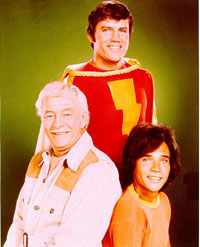
Midway through the second season, Bostwick was replaced by John Davey. In his book,
Myth, Magic, and a Mortal, Bostwick explains that an eye injury sustained on the set resulted in a shooting delay, which prompted the
|
| John Davey took over the role of Captain Marvel, co-starring with Les Tremayne (left) and Michael Gray (right) |
producers of the show to summarily fire him, replacing him with Davey that very afternoon. Filmation claimed the eye injury was ploy on Bostwick's part to increase his salary, but in the end was forced by the Screen Actors Guild to pay Bostwick for the episodes he was contracted for, plus residuals, even though Davey would continue to play the role.
The success of the TV show helped sales of the DC comic series, but the childlike whimsy established in the 1940s proved a hard sell in the 1970s. Captain Marvel was featured alongside Superman, sometimes as an ally, sometimes as a rival. To explain his infrequent appearances among DC’s mainstream titles, it was reasoned that Captain Marvel, like many other longtime characters of the DC Universe, lived on an alternate dimensional world, Earth-S. In time, Captain Marvel gave way to more modern sensibilities, but it wasn't enough.
Shazam! was canceled after 35 issues.
Marvel Comics' version of the good Captain also had it rough, as the 1980s began with his death from cancer. His name was transferred to Monica Rambeau, an African-American woman who, in the course of a lab accident, gained the ability to turn her body into pure energy.
Back at DC, after a handful of infrequent appearances, Captain Marvel was added to the roster of the Justice League in the late 1987. In 1994, artist Jerry Ordway resurrected Captain Marvel for a 25-issue series,
The Power of Shazam. While Superman has maintained a steadier role in comics, Captain Marvel has proven to be a worthy challenger to his dominance. The two heroes would again clash in Alex Ross and Mark Waid's best-selling
Kingdom Come.
Meanwhile, in the Marvel Comics Universe, a second Kree, Genis Mar-Vell assumed the mantle, with the original Mar-Vell slated to return in late 2007. Rather than be resurrected from the dead as other characters have been, this Captain Marvel is a time-traveling younger version of the Kree warrior prior to succumbing to cancer.
Praise and adulation? Scorn and ridicule? Email me at philip@comicbookbin.com
Last Updated: November 29, 2025 - 16:51
 ComicBookBin