Comics /
Cult Favorite
A Ten-year-old's Golden Age
By
Philip Schweier
October 2, 2006 - 17:47
**image5***I remember October 10, 1974 rather vividly. It was my 10th birthday, and one of the gifts I received was The Great Comic Book Heroes, by Jules Feiffer. It was a compilation of essays, as well as an assortment of Golden Age greats such as the Original Human Torch, the Original Green Lantern, and the Original Flash.
It had been published several years before, and perhaps based on the success of that book, DC began reprinting some of its Golden Age stories. To a comic fan like myself, it was quite the thrill to discover that there was an entire generation of super-heroes who had come before the ones that I knew.
The 1970s were a great time to be a comics fan, because not only were the Silver Age characters fully formed and thriving, DC was in the habit of reaching deep into their archives and reprinting some great Golden Age material. Sure, they still do that – but in $30 books, which is often way beyond the price range of a young comic reader.
First there were treasury editions; giant tabloid-sized reprints of Action Comics #1, Batman #1, and Flash Comics #1, among others. For $1, these introduced many a younger fan to their favorite super-hero as they originally appeared some 35 years ago.
|
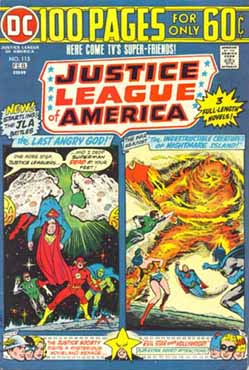
DC was also publishing 100-page Super-Spectaculars, which today are highly sought after by collectors. These were published within the normal run of a title, often being announced the month before, allowing a reader the chance to save a few extra dimes and quarters. Often several issues in succession were 100-Page Super-Spectaculars.
As a kid, I felt a little gypped that the 100 pages included the front and back covers, but today, when I consider what all I got in between, I’m a bit more forgiving. They usually contained a brand new story, possibly a shorter new one as a backup feature. Then the issue was rounded out with stories from the 1940s, ‘50s, and ‘60s. If it were a Justice League issue, you might get a Golden Age JSA story and a Silver Age JLA story. An issue of
Detective Comics would feature many detectives from DC’s stable of characters, such as Star Hawkins, Roy Raymond: TV Detective, and the Elongated Man.
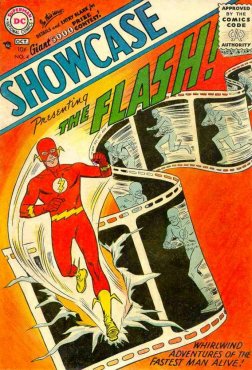
It was later that I learned that many of the heroes of the Golden Age had faded into obscurity, only to be rescued and re-invented under the editorship of Julie Schwartz. At a panel at the 2003 Dragon-Con in Atlanta, Schwartz explains how the Silver Age began. As DC needed a feature for
Showcase #4, it was suggested that it revive the Flash.
“There were objections because the magazine had failed, but at that point I said, ‘Wait a second. It failed in 1950. We're now in 1955, five years later. In those days the age of the average comic book reader was 8-12. Therefore, there were no readers left who remember the Flash.’ So they said, ‘Okay, let's put out the Flash again.’ “
The job fell to Schwartz, and he enlisted office mate Bob Khaniger to work out a more realistic approach. The original Flash got his powers by inhaling the fumes of heavy water – of which there is no such thing – but Schwartz felt there had to be a more logical explanation. “How about if a scientist is working in a laboratory and a bolt of lightning comes in and hits the chemicals and they splash all over him,” said Schwartz. “Well, a bolt of lightning travels 186,000 miles a second.”
The new Flash took his name from New York radio commentator Barry Gray, whom Schwartz was a big fan, and comedian Steve Allen. But now the question came as to who should illustrate it.
Schwartz’s favorite artist at the time was Carmine Infantino. “I said, ‘Give me a new uniform. Give me this. He brings in the art and it's beautiful, but it's deadline time and none of my inkers are available. Another artist happened to be in the office with Khaniger, because he did work for Khaniger. He did war stuff, Sgt. Rock and so on. I said, ‘Joe, can you do me favor? Would you ink one Carmine Infantino story for me? I have a deadline to meet.’ and he said, ‘Well, sure, I'll do it.’ It turned out to be one of the greatest stories of the Flash, Carmine Infantino inked by Joe Kubert.”
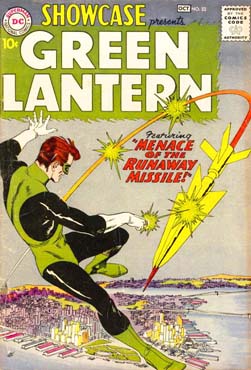
When the sales reports came, the new Flash was a huge success, and in time he was given his own title, with Schwartz editing. “The sales went over the roof so well, they said, ‘Okay, Julie, what would you like to revive next?’ I said, ‘
Green Lantern.’ We put out
Green Lantern. Unbelievable sales. Then they said, ‘What do you want to do next?’ and I said, ‘
Justice Society of America, with all the new heroes put together.’ But I thought, no, I don't like the name ‘society,’ that's a social club. Let's call it Justice League of America.”
In time, the heroes of DC’s Golden Age met their new counterparts, creating the concept of the multiple Earths. Throughout the 1970s, the JLA would team up with the JSA on an annual basis, often with yet a third super-group such as the Marvel Family, the Freedom Fighters of Earth X, or the Legion of Super-Heroes.
With close to 70 years of comic book history, it’s inevitable that some characters need to be updated for a modern audience. Many have undergone some sort of facelift in recent years, first with Superman in 1986, then others, most notably in the wake of the recent Crisis published by DC. Writer Geoff Johns seems to be DC’s go-to guy when it comes to re-imagining characters in need of a facelift.

|
At the same comics panel in Atlanta, Johns explained his approach, citing the Flash’s rogues gallery as an example. “The greatest thing about these rogues is they could come together and if they wanted to possibly take over the whole world, or at least Montana. Mirror Master can walk through mirrors, he can open different dimensions, the Weather Wizard can control the friggin' weather. That's really powerful, but it's the personalities in them that I want to look at, and I looked at them: Why do they do what they do? Well, they do it not because they really want to take over the world. To me, the rogues, they like living hand-to-mouth. You know, they'll pull a heist and then blow all the money on booze and trips to the Bahamas. And then they'll come back and do it again because they like it. And that makes them more interesting too, because that makes them more like people. They're not stupid, but they're not geniuses. They're just regular people who have these amazing weapons.
“So I went through on a case by case basis with the Rogues and tried to figure out what made Captain Cold work, what would make Mirror Master work, etc., and brought them back and had them fight the Flash. And make the Flash work. There is nothing I hate worse than a super-villain that runs out of a bank and slips on a banana peel. Or when villains get together and they argue, so they get defeated because they can't along. You know, half the villains really kick it up a notch, so when the hero finally stops them, it's much more impressive.”
As many heroes continue to age, it takes more than cheap stunts such as weddings, deaths and resurrections to make a character popular. A reader must be able to identify with the character on some level, and establish a connection that makes a reader care about this fictional character’s “life.”
Praise and adulation? Scorn and ridicule? E-mail me at philip@comicbookbin.com
Last Updated: November 29, 2025 - 16:51
 ComicBookBin