Movies /
Home Theatre
The Walking Dead: Is the TV Adaptation Better Than the Comic Books?
By
Dan Horn
December 5, 2011 - 17:05
How far does the undead apple fall from the undead tree?
In 2010 and into 2011, I was deployed to the USMC's Camp Leatherneck in
the secluded Camp Bastion NATO airfield, the main allied operations base
in Helmand Province, Afghanistan. For all I knew, I was on another
planet, what with the incessantly swirling moon-dust of the barren
Helmand landscape and the intemperate heat of summer and cold of winter.
The overall experience itself is a story for another time, however.
This is a pop culture blog and I happen to have an appropriate agenda in
starting this examination of the television series The Walking Dead and
its source material in the deserts of Afghanistan. Please, bear with
me.
I was very lucky, when I think of my time in Afghanistan when compared
to the tours of my brothers in arms who have suffered through so much
worse in theater. In my case, boredom was the most apparent enemy during
the deployment. As a collector and avid reader, comic book withdrawal
made the often sleepless nights long and excruciatingly dull. In
response to a subtle request on my part, my fiancé's father began
sending me assorted comics from a discounted comic lot he had purchased
from a bookstore. This was my metaphorical Nicorette. It curbed my
cravings, but even so, the books I was receiving from that collection
were things like the strange, now-obscure Marvel book
Death's Head and
the
Superboy title that spun out of the 1988 TV series. They did in a
pinch, serving almost solely to give me my sequential art fix. Still, I
needed more. Later, my soon-to-be father-in-law mailed several CDs of
electronic comic books, which I read on my constantly overheating
laptop, that adequately satiated my intellectual voracity. I fell in
love with Brian Q. Miller's
Batgirl and Marjorie Liu's
X-23 in
Afghanistan, books I most likely wouldn't have read otherwise. I was
reintroduced to
Captain Marvel's mind-bending era of psychedelia. I
reread Jeph Loeb's
Long Halloween and read much of Geoff Johns'
post-"Rebirth"
Green Lantern (which I'm still not too fond of).
On my birthday, I received a package from my fiancé that contained
several volumes of Image Comics'
The Walking Dead. At this point I was
ecstatic. I had never bought into
The Walking Dead craze, but not
because I'm one of those jaded cynics that says zombie fiction has all
been done before. Maybe it has, but I'm a zombie-horror junky at heart.
28 Days Later, Romero's original
Night of the Living Dead, the
comedy-horror
Shaun of the Dead, and the 2004 remake of
Dawn of the Dead
rank among some of my favorite films. However, I'm a discerning fan of
the genre; the not-so-discerning zombie fanatics can keep Romero's less
inspired works and the straight to video fare. But, the reason I'd never
been sold on
The Walking Dead was that I'd never been sold on its
writer, Robert Kirkman. I'd honestly not read anything that he'd written
that I could deem, with a clear conscience, truly inspired. The hype
surrounding his zombie epic definitely piqued my interest, though, and I
was eager to dig into the first volume. Sure, hype is always a dubious
barometer for these sorts of things, but what did I have to lose but
time--time that stood between me and homecoming?
WARNING: the following contains some spoilers
The first thing that was glaringly apparent in my first reading of "Days
Gone Bye" was Kirkman's liberal "borrowing" of content from a film that
I've already mentioned,
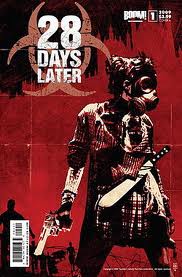
28 Days Later, which now has its own comic book series spin-off. For those who aren't familiar
with Danny Boyle's survival-horror opus, the film follows a man who
wakes from a coma in a London hospital to find that England has been
ravaged by the "rage" epidemic, turning most of the British populous
into mindless, gore-vomiting cannibals. Sound pretty familiar? Take
nearly that entire premise, strip away Big Ben, and add some Georgia
colloquialisms and Southern iconography, like the rural county sheriff
in the smokey-bear, and you've got Kirkman's
The Walking Dead, which was
first released by Image Comics in October 2003, approximately four
months after
28 Days Later first hit theaters. It occurred
to me that Kirkman's
The Walking Dead comic book series was not
developed to much substance, and was a pale American reflection of the
brilliant Boyle film that sparked the most recent pop-cultural fad of
zombie-centric media. It was a Halloween cash-in for Image, and an
effective one at that, spawning a lucrative franchise.
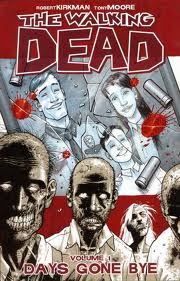
It's a fun story nonetheless, with gorgeous Tony Moore artwork and no
shortage of entertainment value, but it's hampered by clunky dialogue
and shallow characters (we really hardly know anything about most of the
survivors beyond their exterior interactions after the first two
volumes besides those most closely associated with main character Rick
Grimes). Hell, even Rick is something of a cipher who sheds an
occasional tear at Kirkman's behest in ineffective attempts at
developing Rick's personality. The character of Shane, Rick's best
friend and the man that took care of Rick's family (including a sexual
affair with Rick's wife while Rick was in a coma and presumed dead), was
what really drew me in. The tension between Shane and Rick was growing
more and more palpable throughout the first few issues, and it was this
dynamic that seemed to purport the most promising developments for the
series in the future. So, what does Kirkman decide to do with all this
potential? Shane goes berserk in the sixth issue of the comic book
series, and is shot to death by Rick's young son, Carl. It's a powerful
scene, but also shortsighted in the long haul, a desperate and untimely
grab at readership.
|
Without the Shane drama, subsequent story arcs are more than a bit
boring. It really takes quite a long while for the comic book series to
get into its groove, where characters are properly developed and the
scope of the series broadens. This fact leads me to believe the initial
success of the series can be strictly attributed to people who are
willing purchase without regard for quality anything zombie related and
the word-of-mouth hype-machine that demographic created. Let's take a
look at the
Twilight films for example: god-awful movies by almost any
standard and panned critically nearly across the board, yet the
Twilight
faithful remain the
Twilight faithful for the sake of identity, I
assume--why else would you watch that juvenile shit? (says the man
writing about zombies)--and embark on a tireless recruitment campaign
for the
Twilight movement. It's affected the
Twilight franchise
monumentally. I don't know that any film could currently compete
financially with a
Twilight release other than an installment of another
similarly successful, billion-dollar franchise like the
Dark Knight or
Pirates of the Caribbean. The zombie faithful are perhaps a slightly
less galvanized bunch, but their influence on
The Walking Dead's
meteoric rise can't be ignore.
I understand that pointing out the mediocrity that hamstrings
The
Walking Dead early on is a critique of the comic book series that's sure
to earn me some vilification from the die-hard Robert Kirkman fan club,
but doesn't hasty, vitriolic defense of a work of zombie fiction just
kind of prove my point here? I mean, I was making an earnest attempt to
overlook Kirkman's shortcomings in scripting. This was one of the very
scant sources of entertainment that I had at the time I'd first read
"Days Gone Bye" and "Far Behind Us," but those first volumes are so
half-baked, the inattentiveness to detail eclipses any real value of the
story. I was truly trying to like
The Walking Dead and was only ending
up utterly blase in regards to the experience.
However, before the wildly enraged responses begin pouring in, I want to
point out that I stuck with the comic book, and I'm really enjoying it
right now. It's matured from a simple rip-off to a series that really
has it's own two legs to stand on. And maybe that's why the first two
seasons of
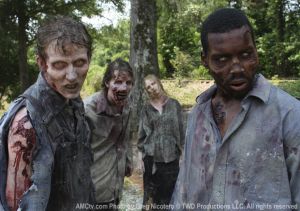
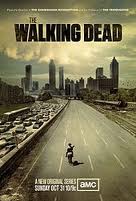
The Walking Dead television adaptation on AMC have done such a
fine job of overshadowing the growing pains of the source material.
AMC's
The Walking Dead is every bit the character study that Robert
Kirkman had intended his comic book series to be from the beginning.
Insightful, introspective, and, most importantly, propelled by the
survivors' collective and personal dynamics, the TV program attains
noticeably darker depths than its graphical counterpart. In my book,
that's definitely a pro--perhaps the only pro it really needs. It's a
mature, intellectual, and human story, which the comic books could
hardly be accused of in 2003 and 2004. Of course comic book medium
detractors would certainly attribute the disconnect between source and
adaptation to the comic book's inability to convey those mature theme's
effectively, but how naive can people possibly be? The derogatory stigma
that hounds the words "comic book" is incredibly tiresome, given the
wealth of literary and artistic value the medium has contributed to
society in the last three decades alone. The disconnect isn't the
medium, but the writing, and I see the changes made to the story as
Robert Kirkman's way of saying, "Yeah, I screwed up and have always
wished I could take this back or add this here. So here it is." It's the
director's hindsight cut, the story he wished he had written.
Speaking of changes to the saga, the television series' propensity for
liberal alterations to Kirkman's original plot has drawn heat and
accolades alike from fandom. I fall on the latter side of the fence,
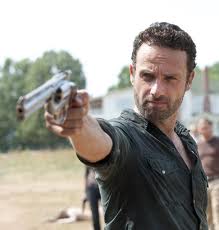
applauding these changes, most of all keeping Shane alive. All of the
brilliant moments from the live action show to which Shane has
contributed only verify my suspicions that his abortive demise in the
comics was an immense misstep in plotting. Seriously, the man
practically makes the show worth watching on his own. The mere fact that
he's still around for Lori's pregnancy makes for some incredibly
intense character moments.
|
Lending depth to Adrea and Amy's relationship before Amy's death,
including Merrill and Darrell, and the ultimate fate of Sophia, Carol's
little girl, on Hershel's farm (not to mention the interesting and
significant changes to the story of Hershel's farm itself) are all
examples of similarly effective tweaks to the original material. Let's
discuss the example of Hershel's farm for a moment, and I'll try to make
my case from that. In the comic books, Hershel became an overtly
patriarchal madman, spouting off things like "You've run your mouth long
enough, woman!" and other equally eye roll-inducing articulations.
Kirkman wanted so badly to write diverse and sympathetic
characterizations--he wanted to write real people--but he just didn't
have the insight needed for the task. He ended up fostering many
unrealistic and incongruous stereotypes. In the second season of the tv
series, Hershel is a sympathetic man, bolstered by blind faith and
closed-mindedness, but convicted by his own compassion. In many ways he
reminds me of my grandparents, subtle racism and all. He honestly could
be the fictional avatar for most Christians, and by the midseason
finale,
The Walking Dead still hasn't made a definitive statement on
whether Hershel is "good" or "bad," though the viewer's heart goes out
to him in the end nonetheless. And that's what makes the television
series so spectacular. It's not nearly so black-and-white, figuratively
nor literally, as its source material. It questions the certainty of
morality in societal collapse and messes about with ambiguous heroics.
Hell, we truly can't even call Shane a "villain," just a troubled man
who's fit for survival in the given circumstances. The series raises questions about the moral implications of survival, not mere survival alone.
There's also been quite a bit of criticism hurled toward the television
show's lengthy story arcs, however. Hearing some of the complaints, like
ones aimed toward this most recent season's dilated search for Sophia,
got me to thinking: The survivors on
Lost were stuck on an enigmatic
island for several years before being rescued, and even then, they
returned to the island! Talk about a prolonged engagement. Of course
this comparison will undoubtedly elicit some groans from
Lost
detractors, but, however you felt about the series' lukewarm ending, if
you watched the show for any length of time, you felt a real connection
with its characters. Jack, Kate, Sawyer, and the rest of the gang were
people, not roles filled by actors. We knew them in what felt like a
very personal way and we wanted to know even more about them.
You see, good character study is a slow cooked provocation that, much like the best
chili, takes some investment of time from the consumer/preparer alike. Sure,
the survivors of
The Walking Dead seemed to spend an inordinate amount
of time searching for Sophia, but the length of the search gave the
survivors more opportunity for crucial interaction and made the payoff
all the more gut-wrenching. There's no shortage of thrills along the
way, but substance is most obviously the paramount goal here. To truly
benefit from the work, you have to be in it for the long haul. That is
the nature of the proverbial beast. If character study really isn't your
thing, tune in to
CSI or some other one-crime-a-week franchise, or, if
you prefer your character dramas a bit less comprehensive, I suggest
reading Robert Kirkman's comic books.
Last Updated: November 29, 2025 - 16:51
 ComicBookBin