Comics /
Comic Reviews /
More Comics
Lost at Sea
By
Zak Edwards
August 29, 2010 - 18:38
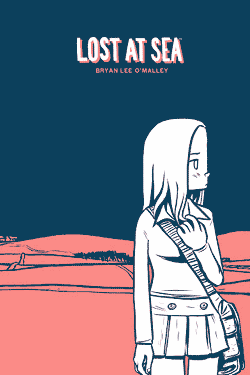
I picked up this book on a whim at a sale at my local comic book store, curious to see Bryan Lee O’Malley’s earlier work before the comic genius of the Scott Pilgrim series. I honestly had no idea what to expect apart from the blurb and endorsements on the back (including one by Craig Thompson, who is actually sort of close to finishing his next project). My lack of expectations is a good thing too, because it turns out Bryan Lee O’Malley used to be less funny and much more introspective, relying much less on pop culture references and more on the ability to convey emotions through a very long monologue. Lost at Sea is, as suggested on the back, a book about the confusion and isolation of adolescence, and is entirely without Super Nintendo or even self-referential humour.
That is to say, Bryan Lee O’Malley has a great handle on characters and has only gotten better with time. I would almost call it unfair to compare Lost at Sea to Scott Pilgrim, if only because they are so different in their approaches to the trials of adolescence or, in the latter's case, the need to leave such a position. Lost at Sea is more focused on a very internal struggle, if only showing the work of a less realized creator. The book follows Raleigh, a girl who is road-tripping back to Vancouver after spending time in California with some people she went to high school with, and a point of her journey of self-discovery and movements through the tolls of both life and the awkwardness of adolescence. O’Malley is clumsy at times in this book, which never has a sign of relief in the general downer mood. Moments of helplessness and depression are followed by similar moments, and the protagonist has long moments of monologue which depict a reliance on words over images as well as making sure no detail is left up to the reader. Indeed, the book reads almost like an illustrated storybook over graphic novel at times. Raleigh is, however, an engaging protagonist, even if she is quite a sad and miserable character for much her own faults, and it is O’Malley’s abilities with this character that help this book from becoming a full-on moan about how much it sucks to be the teenager of divorced parents, as if this is a unique and never explored subject by thousands of others. Raleigh’s story, and her acknowledgment of the ramblings she has, makes Lost at Sea a more powerful work, not afraid to not fully articulate while still conveying everything. The book trends a line frequently crossed into the obvious and heavy-handed, but there are moments when Raleigh has some wonderful moments of terrible beauty and genuine characterization. Raleigh is an introverted character who can still make use of people, and this ability comes across in her contradictions in the story itself, as if her narration is an act of guarded confession and the truth is more complex than what happened and what didn’t. So while Raleigh does over-narrate, she is mostly a character which is fairly complex, something which can be seen in O’Malley’s later work. Unfortunately, the book does eventually rely on a big “we like you and we’re friends, didn’t you know?” moment to act as a sort of falling action, bringing in the cliches of the line O’Malley is treading all over the story, but these moments at the end of the book do not detract from the whole experience significantly. The climactic act, focusing on a cat hunt, is where the book is at its best, showing O’Malley’s ability to have characters interact in extremely relatable and normal ways, something of a highlight of the creator’s work. So while Lost at Sea has a few problems, O’Malley’s first major work is also one of great beauty and hints of things to come.
Grade: B Has moments of both power and cliche, an excellent initial work for a talented creator.
Last Updated: January 1, 2026 - 11:07
 ComicBookBin