Movies /
Comics Movie Reviews
Cabin in the Woods: Writers and Audiences
By
Zak Edwards
April 29, 2012 - 21:15
Cabin in the Woods, as co-writer Joss Whedon has mentioned, is a film about writing. It discusses the writing process at length and uses what I call the “office scenes,” the scenes where the people are orchestrating the horror part of the film, to continually comment on the events while providing some tonal relief. Drew Goddard and Joss Whedon manage to balance the movie brilliantly, never going overboard while keeping the focus on the below the surface workings of the events rather than simply relying on the sensationalism of the horrors occurring. As my friends and I discussed afterwards, it takes a pretty methodical and conscious approach to have a girl being brutally murdered with a bear trap in the background of an office party and play it for a chuckle.
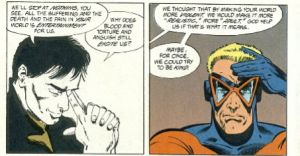
What I find interesting about the film in many ways is not the commentary on writing in general but the commentary of writing for someone. After all, the office group are trying to appease the Old Ones, the Ancient Gods, with a repetitive and specific story, and the requirements of such make the protagonists fit into extremely narrow confines in order to appease these dangerous and higher beings. I feel that Cabin in the Woods is less about writing and more about appeasing and, if these office scenes can be seen as the writers in this metaphor, than those being appeased must be the audience. Yes, the sadism of the act of writing is probably one of the major points of the film, the idea that a writer can dream up believable fictional creations and subsequently make them suffer in new and exciting ways, but the film also sets its sights on those wanting to engage such material as well. In this sense, Whedon and Goddard draw heavily from Grant Morrison’s final issues on Animal Man.
|
In the wake of audience reactions to Mass Effect 3, as I have discussed
before (a couple of
times), I found this film interesting when considering the eager audience. Whedon himself has discussed the frustrating evolution of the fan in the wake of the Internet and how it appears that, above all, writers must now cater more than ever. If ever there was a film about such fearful succumbing, it must be Cabin in the Woods.
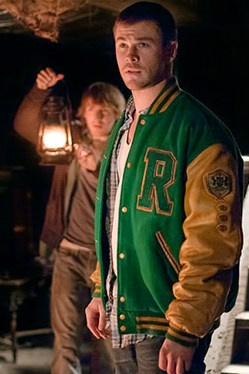
The characters in the horror part of the film have two primary focuses: their adherence to a specific role and their choice in how they die. According to the ritual outlined at the end, there must be a certain number a sacrifices that occur in a rough order. Four must die: the Whore first, the Athlete, the Fool, the Scholar, and then the optional death of the Virgin. What makes this interesting is how the characters are forced to occupy these roles. Cabin in the Woods actually does the reverse of what Whedon does so well and flattens characters and reverses character development. The Fool, brilliantly played by Dollhouse’s Franz Krantz, points out how his friends are changing as an example of this flattening. Jules, as

|
he mentions, is an intelligent and capable med student and her boyfriend Curt is hardly the drunk and horny alpha male, himself being a smart sociology major who gives Dana advice on what to read (rather than tips on how to avoid schoolwork) to do well in school. By the time Jules is killed, however, she fully encapsulates the blonde archetype required. Curt similarly devolves into action packed and fairly ridiculous acts of stupid valor. The characters, while not fully rounded at the beginning, offer multiple hints of being developed, but must be simplified and flattened to adhere to the guidelines of the Director, who requires these stocks in order to be successful. Success here is succumbing to the perceived desires of the Old Ones, the metaphorical demanding audience. Play it wrong and they will get angry, play it right and they will comply. But if the plot and movie must ultimately play out in this specific way, the choice the characters make is actually an intelligent piece of satire.
The emphasis on being given a choice is ultimately hopeless. The cast may be able to choose, however unwittingly, but ultimately the result must be the same. The window-dressing changes, the film argues, but it all remains the same in the end. The characters die in the right order, the Old Ones are satiated, life returns to a world of baby-proofing cabinets and planning for futures we don’t actually want. The discussion between the two office characters at the beginning is not simply well-written banter, it’s the thesis of the film: their success limits and simplifies, it satisfies without really thinking why.
The film ends on a note of ultimate revolution, the complete destruction to allow for other things to emerge, and it’s no coincidence that the hand that bursts through the underbelly is fairly infantile. Whedon and Goddard, I believe, are giving backhanded encouragement, saying “Fine, you try it” with a hope that someone will come along and change the game. These are two bored creators who want to be respected and surpassed. So, while the movie is fairly obviously about writing, I believe it is actually trying to consider the audience, what they could be given, and what they want could be ultimately more dangerous than anything else.
Last Updated: November 29, 2025 - 16:51
 ComicBookBin