Movies /
Home Theatre
Bava Box Volume 2 (Part 2_
By
Al Kratina
November 24, 2007 - 23:00
The Bava Box, Volume 2 (Part 2)
Released by Anchor Bay/Starz Home Entertainment
Color
Running Time: 718 Minutes
Rating: Unrated
Website: Buy it here.
In the first part of the Bin’s Bava Box review, we took a look at some of the films representing the horror maestro’s attempts to break with the genre that made him famous. Though movies like Black Sunday and Planet of the Vampires helped define his career, Bava worked in other genres as well, making each his own with beautiful cinematography, an eye for the unusual, and a contempt for screenwriting so profound it could only stem from either a Lewis Carroll addiction or functional illiteracy. But a collection of Mario Bava’s works would never be complete without at least some of his horror films, and Anchor Bay/Starz’ box set contains a few of Bava’s best, and best known, horror films.
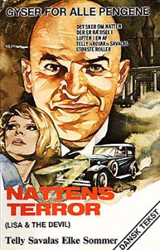
Lisa And The Devil/House of Exorcism
1973, Italy
Directors: Mario Bava, Alfredo Leone
Writers: Mario Bava, Alberto Cittini (
House of Exorcism), Alfredo Leone, Giorgio Maulini (uncredited), Romano Migliorini (uncredited), Roberto Natale (uncredited), Francesca Rusishka (uncredited)
Producers: Alfredo Leone, Jose Gutierrez Maesso (
House of Exorcism)
Starring: Telly Savalas, Elke Sommer, Sylva Koscina, Alessio Orano
Genre: Horror
Rating: R
Running Time: 95 minutes
Perhaps Bava’s most famous film, Lisa and the Devil is also his most truly successful. A dreamy and suspensful film, Lisa and the Devil works mainly because the film appeals to the part of the brain that doesn’t require narrative or causality for stimulation, that reacts emotionally and reflexively to aesthetics and imagery instead of linearity and logic. You know, the part that makes people watch music videos and convinces them that most anime is exciting experimentation instead of visual gibberish. Lisa and The Devil is a dreamscape set in a nightmare, but one that drifts in endless circles instead of riding adrenaline to its destination. In the film, Bava regular Elke Sommer plays a young woman who wanders away from her tour bus and into the clutches of a delicately debauched family of aristocrats. Once she arrives, she’s startled to discover that everyone at the house inexplicably recognizes her, while everyone watching recognizes the butler as Kojak, complete with the lollipop and Long Island accent. Telly Savalas’ cannibalization of his own role aside, the nightmarish film slowly spirals into insanity before a brief orgy of violence sets the tone for a colourful but confusing ending.
House of Exorcism, on the other, hand, is not successful, at least in an artistic sense. Financially, shooting additional footage of The Exorcist transposed to the level of Italian daytime television may have made the producers a bundle, but the distasteful possession scenes continually interrupt the flow of the film and derail the momentum, like being constantly woken up from a wet dream by spiders crawling over your face.
Bay Of Blood (aka Twitch of the Death Nerve)
1971, Italy
Director: Mario Bava
Writers: Franco Barberi (story), Mario Bava, Filippo Ottoni, Dardano Sacchetti (story), Giuseppe Zaccariello
Producers: Giuseppe Zaccariello
Starring: Claudine Auger, Luigi Pistilli, Claudio Camaso, Anna Maria Rosati
Genre: Horror
Rating: R
Running Time: 84 minutes
Genealogy is a fascinating subject. When I researched my own ancestry, I hoped to find a lineage stretching back to Slavic kings, justifying my sense of nobility and entitlement. Turns out I’m related to carnival folk and a sports reporter in Kansas. I don’t know what’s more embarrassing; my great-grandfather being birthed into a pile of stolen wallets and tarot cards, or that college football and monster truck rallies run in my blood. In any case, the genealogy of film is no less interesting. For every seemingly breakthrough movie, there’s a long history of antecedents and predecessors. Many slasher films descend from the incestuous inbreeding of Halloween sequels, a coupling that led to less successes like Scream than buck-toothed degenerates like Urban Legend. But they all can be traced back to Bay of Blood, aka Twitch of the Death Nerve, a Bava film that pioneered the elements that later defined the genre, from the amorous teenagers to the pseudo-sexual obsession with impalement to what I’m pretty sure is Mrs. Voorhees’ sweater from the first Friday the 13th. In any case, Bay Of Blood, about a string of murders that slaughters the inhabitants of an island, is an extremely important film in horror history, and a must-see for fans of slashers, Bava, and inbreeding.
Rabid Dogs/Kidnapped
1974, Italy
Director: Mario Bava, Lamberto Bava (Kidnapped, uncredited)
Writers: Alessandro Parenzo, Cesare Frugoni (uncredited)
Producers: Lamberto Bava, Alfredo Leone, Roberto Loyola
Starring: Riccardo Cucciolla, Don Backy, Lea Lander, Maurice Poli
Genre: Thriller, Crime, Action
Rating: Not Rated
Running Time: 96 minutes
Despite the legacy he left in horror, Bava’s most intense film was in a different genre altogether. But when a financier died during the postproduction of crime thriller Rabid Dogs, the print became entangled in bankruptcy litigation, remaining locked away long after Bava’s death. Finally, in the late 90s, producers gained access to the work print, and decided to find the best way to ruin it. They enlisted the help of Bava’s son Lamberto in shooting new footage that had an effect not unlike mixing finely aged wine with Welch’s grape juice and poisoned Kool Aid. Included on Starz’ excellent DVD are both Bava’s original and Kidnapped, the re-edit, and the former is vastly superior. Exploitation at its finest, the film departs from Bava’s delirious Gothic excess and instead presents a hard-edged crime thriller about a group of criminals escaping from a botched robbery. They take a father and son hostage, along with a young woman, but their own mental instability dooms their voyage from the very start. The ending is grimly inevitable, but takes an entirely unexpected twist in the final moments, as rabid dogs tend to.
The DVDs all feature commentary from Bava scholar Tim Lucas, and the Rabid Dogs/Kidnapped disc contains a behind the scenes documentary.
Rating: 9 on 10
alkratina@comicbookbin.com
Last Updated: November 29, 2025 - 16:51
 ComicBookBin